


Page 606 - The Book of Caterpillars: A Life-Size Guide to Six Hundred Species From Around the World
P. 606
MOTH CATERPILLARS

                                                     FAMILY  Noctuidae
                                                 DISTRIBUTION  Europe and across central Asia, through Siberia to Korea; also
                                                          eastern and western parts of North America, where introduced
                                                    HABITAT  Shingle banks, waste ground, and verges


                                                  HOST PLANTS  Common Toad ax (Linaria vulgaris) and Dalmatian Toad ax
                                                          (Linaria dalmatica)
                                                      NOTE  Colorful caterpillar that is sometimes used as a biological weedkiller
                                             CONSERVATION STATUS  Not evaluated, but locally rare


            ADULT WINGSPAN
           1–1¼ in (25–32 mm)
           CATERPILLAR LENGTH
             1 ⁄   in (40 mm)
                                                                           CALOPHASIA LUNULA
                                                        TOADFLAX BROCADE
    604
                                                                                   [HUFNAGEL, 1766]


                                            Toad ax Brocade caterpillars hatch from up to 80 eggs laid by the
                                            female moth on the food plant. The larvae have a huge appetite

                                            and grow quickly,  rst eating all the young leaves and  ower

                                            buds, and then stems and older leaves. There are usually two
                                            generations a year and they may overlap in summer, the moths
                                             ying in May to August, and July and August. The reddish-

                                            brown pupae of the second generation overwinter, either in the
                                            soil, or on or within the lower stems of the host plant.


                                            The distribution of this species is limited by the occurrence of its

                                            food plant. It feeds mostly on Common Toad ax but has been
                                            seen on naturalized varieties and closely related species. In some
                                            parts of the world where its host plant is considered a noxious
                                            weed, the moth has been used for biological control, for example
                                            in parts of southern Europe, and also in North America, where
                                            the species was introduced during the 1960s.


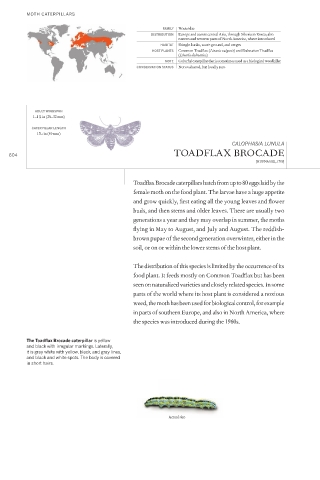
          The Toad ax Brocade caterpillar is yellow
          and black with irregular markings. Laterally,
          it is gray white with yellow, black, and gray lines,
          and black and white spots. The body is covered
          in short hairs.


                                                       Actual size

