


Page 608 - The Book of Caterpillars: A Life-Size Guide to Six Hundred Species From Around the World
P. 608
MOTH CATERPILLARS

                                                     FAMILY  Noctuidae
                                                 DISTRIBUTION  Western and central Europe, Iceland, Scandinavia, east across
                                                          Russia and Siberia to Sakhalin Island and Magadan; introduced in
                                                          Newfoundland (northeastern Canada)
                                                    HABITAT  Open grasslands, particularly in acid uplands and in cool climates;
                                                          also in warmer lowlands on well-drained soils
                                                  HOST PLANTS  Grasses, particularly hard-bladed species such as Mat-grass
                                                          (Nardus stricta), Purple Moor-grass (Molinia caerulea), and
                                                          Sheep’s-fescue (Festuca ovina); also sedge (Cyperaceae)
                                                      NOTE  Usually inconspicuous caterpillar that can sometimes
                                                          occur in “armies”
                                             CONSERVATION STATUS  Not evaluated


            ADULT WINGSPAN
             ⁄  –1 ⁄   in (24–39 mm)
           CATERPILLAR LENGTH


           1 ⁄  –1⅜ in (30–35 mm)
                                                                         CERAPTERYX GRAMINIS
                                                                   ANTLER MOTH
    606
                                                                                   (LINNAEUS, 1758)


                                            The Antler Moth caterpillar hatches in March or April and
                                            develops, feeding mainly at night, until June. At later instars,
                                            when larger, it hides deep in the grass by day. Although the


                                            larvae are di cult to detect, small birds such as the Whinchat
                                            (Saxicola rubetra) spot and often take them. When fully fed, the
                                            caterpillar forms a pupa in a chamber in the ground among grass
                                            roots. There is one generation annually, and the distinctively
                                            marked, brown-and-cream adults  y from July to September by

                                            day and by night. The tough, rounded, grayish eggs are laid as

                                            the female  ies low over grassland, and this stage overwinters.

                                            Caterpillar numbers sometimes build up to high levels, and the
                                            larvae may defoliate large areas of hillside, feeding by day and
                                            night in “armies.” Later instars of the closely related Feathered
                                            Gothic (Tholera decimalis) and Hedge Rustic (T. cespitis) look
                                            very similar and have very similar habits.


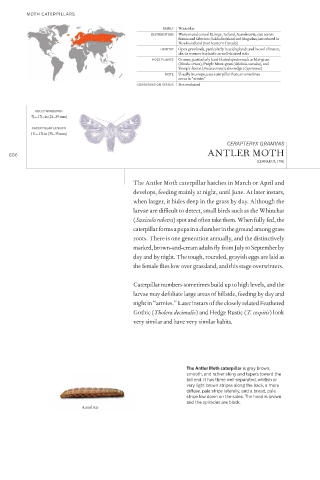
                                                             The Antler Moth caterpillar is gray brown,
                                                             smooth, and rather shiny and tapers toward the
                                                             tail end. It has three well-separated, whitish or
                                                             very light brown stripes along the back, a more
                                                             di  use, pale stripe laterally, and a broad, pale
                                                             stripe low down on the sides. The head is brown
                                                             and the spiracles are black.
                           Actual size

