


Page 625 - The Book of Caterpillars: A Life-Size Guide to Six Hundred Species From Around the World
P. 625
MOTH CATERPILLARS

                      FAMILY  Noctuidae
                  DISTRIBUTION  From northern Portugal, central Spain, western France, the
                           British Isles, and southern Scandinavia across Europe to Asia
                           Minor, the Caucasus, and western Siberia
                     HABITAT  Woodlands, wooded hedgerows, other open country with large
                           oak trees, parklands, and mature gardens
                  HOST PLANTS  Mainly oak (Quercus spp.); also recorded on poplar (Populus spp.),
                           willow (Salix spp.), plum (Prunus spp.), and elm (Ulmus spp.)
                      NOTE  Light bluey-green caterpillar with white hairs and white warts
             CONSERVATION STATUS  Not evaluated


                                                                                   ADULT WINGSPAN
                                                                                  1 ⁄  –1⅝ in (34–42 mm)
                                                                                  CATERPILLAR LENGTH
                                                                                  1½–1⅝ in (38–42 mm)
            LITHOPHANE ORNITOPUS
            GREY SHOULDER-KNOT                                                                   623

            (HUFNAGEL, 1766)


            The Grey Shoulder-knot caterpillar hatches from a ribbed,
            whitish egg laid on a twig or branch; eggs are laid either singly
            or in small groups. The larva feeds singly on the leaves of its
            host plant, where it also rests, as it develops through all instars
            from April to June. The caterpillar then descends the tree and
            constructs a tough, silk cocoon in the ground and lies dormant
            within it for several weeks before forming a pupa. The adults
            emerge from September and are active until November,
            overwintering and mating in the spring. There is just one
            generation a year.


            The larvae of a large number of noctuid moth species feed on
            oak and other trees in the spring, and are also often colored green
            or blue green, with white patterning and lines. However, unlike
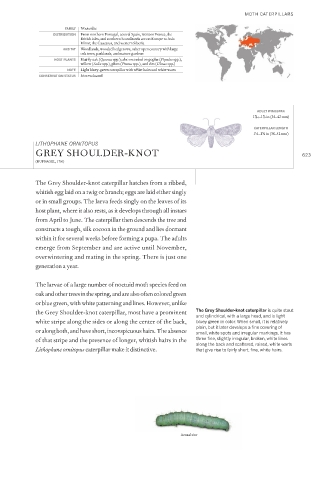
            the Grey Shoulder-knot caterpillar, most have a prominent   The Grey Shoulder-knot caterpillar is quite stout
                                                                and cylindrical, with a large head, and is light
            white stripe along the sides or along the center of the back,   bluey green in color. When small, it is relatively
            or along both, and have short, inconspicuous hairs. The absence   plain, but it later develops a   ne covering of
                                                                small, white spots and irregular markings. It has
            of that stripe and the presence of longer, whitish hairs in the   three   ne, slightly irregular, broken, white lines
            Lithophane ornitopus caterpillar make it distinctive.  along the back and scattered, raised, white warts
                                                                that give rise to fairly short,   ne, white hairs.


                                                           Actual size

