


Page 626 - The Book of Caterpillars: A Life-Size Guide to Six Hundred Species From Around the World
P. 626
MOTH CATERPILLARS

                                                     FAMILY  Noctuidae
                                                 DISTRIBUTION  Europe, excluding northern Scandinavia; Libya; Asia Minor;
                                                          the Middle East; across southern Asia through Iran, Afghanistan,
                                                          and northern India to southeast China; across Russia and Siberia
                                                          to Japan and Russian Far East
                                                    HABITAT  Cultivated land, but also in many other, mainly open habitats
                                                  HOST PLANTS  Many wild and cultivated species, especially Cabbage (Brassica
                                                          oleracea) and other Brassica crops, clematis (Clematis spp.),
                                                          Apple (Malus pumila), and plants of Solanaceae, Fabaceae,
                                                          and Asteraceae
                                                      NOTE  Highly polyphagous caterpillar that is notorious for ruining
                                                          cabbage crops
                                             CONSERVATION STATUS  Not evaluated, but widespread and common


            ADULT WINGSPAN


           1⅜–2 in (35–50 mm)
           CATERPILLAR LENGTH
           1¾–2 in (45–50 mm)
                                                                          MAMESTRA BRASSICAE
                                                                 CABBAGE MOTH
    624
                                                                                   (LINNAEUS, 1758)


                                            The Cabbage Moth caterpillar hatches from a brownish egg laid
                                            in large batches of 20 to 100 on the underside of a leaf. It feeds,
                                            mainly at night, usually on the leaves, and hides by day, often,
                                            when large, at ground level around the plant base. The caterpillar
                                            burrows 2–4 in (50–100 mm) into the ground to form its
                                            pupa in a thin cocoon. There are several generations a year,
                                            and the larvae are most abundant in late summer and fall. The
                                            night- ying adults are present from May to October.


                                            The caterpillar is a pest in many countries on a range of
                                            herbaceous crops, but it is most frequent and damaging
                                            on cabbages, burrowing deep into the hearts, rendering

                                            them inedible. Super cially, it resembles other noctuids, and
                                            well-marked brown forms with dark bars along the back,
                                            emboldened near the tail end, are not dissimilar to some members
                                            of the Noctuinae subfamily. Green forms also resemble other
                                            species. However, in both brown and green forms, the build,
                                            large head, obscurely mottled pattern, and lifestyle of the
                                            Cabbage Moth caterpillar help to identify it.


                       Actual size
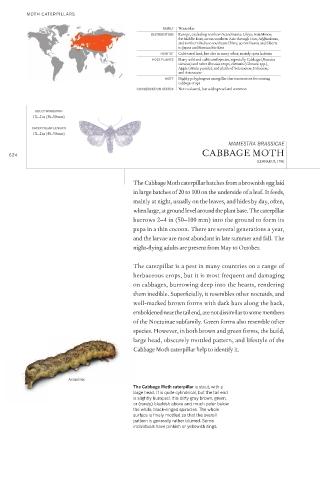
                                            The Cabbage Moth caterpillar is stout, with a
                                            large head. It is quite cylindrical, but the tail end
                                            is slightly humped. It is dirty gray brown, green,
                                            or (rarely) blackish above and much paler below
                                            the white, black-ringed spiracles. The whole
                                            surface is   nely mottled so that the overall
                                            pattern is generally rather blurred. Some
                                            individuals have pinkish or yellowish rings.

