


Page 627 - The Book of Caterpillars: A Life-Size Guide to Six Hundred Species From Around the World
P. 627
MOTH CATERPILLARS

                      FAMILY  Noctuidae
                  DISTRIBUTION  From northern Spain across most of Europe (excluding northern
                           Scandinavia), Asia Minor, parts of the Middle East, and east across
                           Asia to Russian Far East, Japan, and China
                     HABITAT  Shaded and more open habitats—woodlands, scrub, hedgerows,
                           and gardens
                  HOST PLANTS  Many herbaceous and woody plants, including dock (Rumex spp.),
                           Common Nettle (Urtica dioica), plantain (Plantago spp.), elder
                           (Sambucus spp.), Wild Barberry (Berberis vulgaris), and dogwood
                           (Cornus spp.)
                      NOTE  Distinctive caterpillar that has chevrons and a hump
             CONSERVATION STATUS  Not evaluated


                                                                                   ADULT WINGSPAN


                                                                                  1⅜–2 in (35–50 mm)
                                                                                  CATERPILLAR LENGTH
                                                                                  1⅝–1¾ in (42–45 mm)
            MELANCHRA PERSICARIAE
            DOT MOTH                                                                             625

            (LINNAEUS, 1761)


            Dot Moth caterpillars hatch from pinkish-brown eggs laid
            singly or in batches on the food plant. The larvae feed on the
            foliage, generally resting low down on the food plant when
            larger, but may be active by day as well as at night. They develop
            slowly from July into the fall and then form a pupa in a cocoon
            in the ground, which overwinters. There is one generation
            a year. The adults, whose dark brown forewings feature a
            prominent white mark that gives the species its common
            name,  y in June and July.


            The caterpillar’s distinctive markings make it fairly unmistakable.
            However, because it often rests in a hunched position, as do
            caterpillars of the Plusiinae subfamily (which are less smooth),
            it could be confused with the Spectacle (Abrostola tripartita) and
            Dark Spectacle (A. triplasia). Both also have dorsal chevrons
            and a tail hump but are smaller, with a smaller head and stronger
            white markings. Middle instar Dot Moth caterpillars, which are
            humped but lack darkened chevrons, might be mistaken for the
            Burnished Brass (Diachrysia chrysitis), although that caterpillar
            has three instead of four pairs of prolegs.


                                                                            Actual size
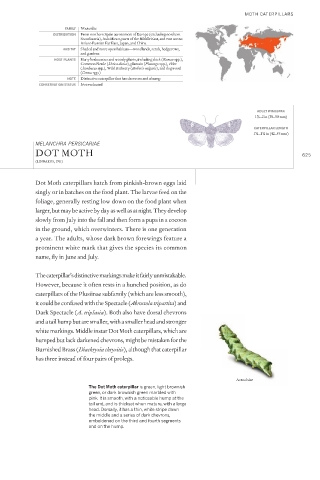
                             The Dot Moth caterpillar is green, light brownish
                             green, or dark brownish green marbled with
                             pink. It is smooth, with a noticeable hump at the
                             tail end, and is thickset when mature, with a large
                             head. Dorsally, it has a thin, white stripe down
                             the middle and a series of dark chevrons,
                             emboldened on the third and fourth segments
                             and on the hump.

