


Page 628 - The Book of Caterpillars: A Life-Size Guide to Six Hundred Species From Around the World
P. 628
MOTH CATERPILLARS
FAMILY Noctuidae
Europe (excluding northern parts of Scandinavia), Asia Minor,
Europe (excluding northern parts of Scandinavia), Asia Minor,
DISTRIBUTION Eur ope (ex c l uding no rther n p arts of Scandin a via), Asi a Minor ,
TRIBUTION
DIS
DISTRIBUTION
southwest Russia, the Caucasus, and Turkmenistan
south west R ussi a, the C aucasus , and T ur km enistan
southwest Russia, the Caucasus, and Turkmenistan
o
ws
er
, hedg
W
d gardens
Woodlands, hedgerows, open areas with scrub, and gardens
r
ub
, an
en areas with sc
oodl
, op
ands
HABITAT
HABIT
HABITAT T Woodlands, hedgerows, open areas with scrub, and gardens
A
nts
, inc
Herbaceous plants, including dock (
luding dock (
Herba
ceous pla
HOST PLANTS
HOS T PLANT S Herbaceous plants, including dock (Rumex spp.), Primrose
HOST PLANTS
( (Primula vulgaris i s
u
mu
ri
l
a v
(Primula vulgaris), Common Nettle (Urtica dioica), and Foxglove
lg
P
ar
li
ig
it
D
( (Digitalis purpurea a
(Digitalis purpurea); woody plants and bushes, including Bramble
s p
u
rp
u
a
re
u
ub
R
r
(Rubus fruticosus) and willow (Salix spp.)
s f
ic
ut
o
( (Rubus fruticosus s
su
onspicu
ous b
pots
, pale br
lac
k side s
mp
o
Plump, pale brown caterpillar that has conspicuous black side spots
Plu
wn cater
t has c
illar tha
p
NO TE Plump, pale brown caterpillar that has conspicuous black side spots
NOTE
NOTE
valuated
Not evaluated
Not e
A
TUS
T
CONSERV
CONSERVATION STATUS Not evaluated
CONSERVATION STATUS
TION S
A
ADULT WINGSPAN
1¾–2 in (45–50 mm)
CATERPILLAR LENGTH
2–2⅛ in (50–55 mm) NOCTUA FIMBRIATA
BROAD-BORDERED
YELLOW UNDERWING
626
(SCHREBER, 1759)
Broad-bordered Yellow Underwing caterpillars hatch from
greenish eggs, laid in batches on the host plant in early fall. The
caterpillar feeds at night, throughout the fall, then overwinters
near the ground and completes its growth in April or May, again
feeding at night and hiding near the ground during the day.
The pupa is formed in the ground. There is one generation
a year, with the adults emerging in July and estivating for several
weeks before breeding.
In the caterpillar’s nal instar, the light brown color and bold,
black lateral spots make the Broad-bordered Yellow Underwing
conspicuous after dark, when it is easily found by using a
ashlight as it comes up to feed. Earlier instars, without the black
spots, are less distinctive. Noctua tirrenica, only described as
a distinct species in 1983 and found in southern Europe,
North Africa, Turkey, and the Caucasus, has very similar habits
and a very similar caterpillar. Its adults resemble pale forms
of N. mbriata.
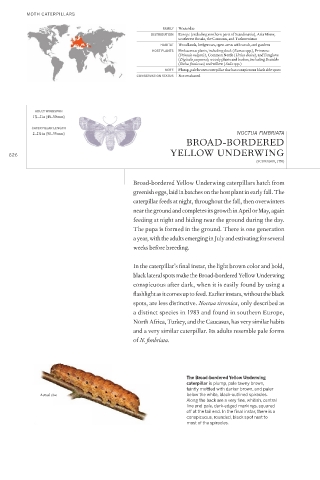
The Broad-bordered Yellow Underwing
caterpillar is plump, pale tawny brown,
faintly mottled with darker brown, and paler
Actual size below the white, black-outlined spiracles.
Along the back are a very ne, whitish, central
line and pale, dark-edged markings, squared
o at the tail end. In the nal instar, there is a
conspicuous, rounded, black spot next to
most of the spiracles.

