


Page 631 - The Book of Caterpillars: A Life-Size Guide to Six Hundred Species From Around the World
P. 631
MOTH CATERPILLARS

                      FAMILY  Noctuidae
                  DISTRIBUTION  Northern and southern Europe, east across Asia to Korea
                           and Japan
                     HABITAT  Coniferous forests, especially those of a cool, humid type
                  HOST PLANTS  Various coniferous trees, especially spruce (Picea spp.);
                           also pine (Pinus spp.) and European Larch (Larix decidua)
                      NOTE  Hairy caterpillar found in the canopy of conifer trees
             CONSERVATION STATUS  Not evaluated, but locally rare


                                                                                   ADULT WINGSPAN
                                                                                  1 ⁄  –2 in (40–50 mm)
                                                                                  CATERPILLAR LENGTH
                                                                                  1¾–2⅛ in (45–55 mm)
            PANTHEA COENOBITA
            PINE ARCHES                                                                          629

            (ESPER, 1785)


            Pine Arches caterpillars hatch from yellow eggs laid in clusters
            on the needles of coniferous trees in late summer. The larvae
            stay in the canopy, where they feed on needles as they develop.
            Their coloring and form provide excellent camouflage,
            so they can rest openly, lying along narrow branches. The hairs
            of the caterpillars also contain irritants, giving the caterpillars
            some protection from predation. The mature larvae move to
            the ground, incorporating hairs into their cocoon for extra
            protection and also for camou age when they pupate.


            The chestnut-brown pupa overwinters, and the adult then
            emerges the following spring. The moths, which have a
            distinctive black-and-white, zigzag patterning, are on the wing
            from early May to August, and there is one generation a year.
            The range of this moth species has been expanding in recent
            decades due to the increased establishment of conifer plantations,
            especially plantations of spruce.


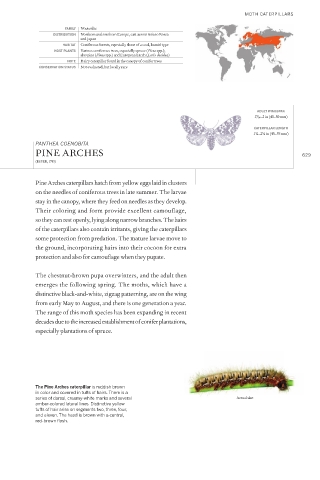
            The Pine Arches caterpillar is reddish brown
            in color and covered in tufts of hairs. There is a
            series of dorsal, creamy-white marks and several                Actual size
            amber-colored lateral lines. Distinctive yellow
            tufts of hair arise on segments two, three, four,
            and eleven. The head is brown with a central,
            red-brown   ash.

