


Page 630 - The Book of Caterpillars: A Life-Size Guide to Six Hundred Species From Around the World
P. 630
MOTH CATERPILLARS

                                                     FAMILY  Noctuidae
                                                 DISTRIBUTION  Central Europe into southwest Russia, Georgia, and Turkey
                                                    HABITAT  Dry, open steppe, grasslands, and undisturbed areas around
                                                          cultivated  elds

                                                  HOST PLANTS  Spurge (Euphorbia spp.)

                                                      NOTE  Caterpillar from the steppes of Europe that e ectively
                                                          defoliates spurge
                                             CONSERVATION STATUS  Not evaluated, but common


            ADULT WINGSPAN
             ⁄  –1 ⁄   in (24–27 mm)
           CATERPILLAR LENGTH
           1–1 ⁄   in (25–30 mm)
                                                                         OXICESTA GEOGRAPHICA
                                                      GEOGRAPHICAL MOTH
    628
                                                                                   (FABRICIUS, 1787)


                                            The Geographical Moth caterpillars hatch from eggs laid in
                                            large batches of around 300 on the underside of leaves of the
                                            host plant. The larvae are gregarious at  rst, living together in

                                            groups of up to 30. They spin a silken web over the host plant,
                                            feeding  rst on the  ower buds and young leaves before moving


                                            on to the older leaves, capable of defoliating the whole plant.
                                            The  fth instar is solitary and pupates in a pale yellow cocoon

                                            that it spins on a stem. The species overwinters as a pupa.

                                            The moths appear in April and May, and there is usually a single
                                            generation. Trials have been conducted into the use of Oxicesta
                                            geographica as a biological control agent for leafy spurge
                                            (Euphorbia esula), an aggressive perennial weed found across
                                            North America, where it is a major problem on grasslands and
                                            has proved resistant to control through herbicides.


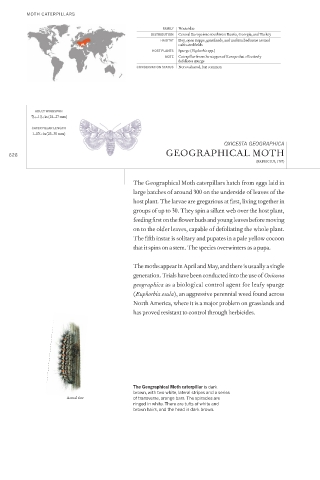
                                            The Geographical Moth caterpillar is dark
                                            brown, with two white, lateral stripes and a series
                      Actual size           of transverse, orange bars. The spiracles are
                                            ringed in white. There are tufts of white and
                                            brown hairs, and the head is dark brown.

