


Page 87 - The Book of Caterpillars: A Life-Size Guide to Six Hundred Species From Around the World
P. 87
BUTTERFLY CATERPILLARS

                      FAMILY  Hesperiidae
                    TRIBUTION
                  DISTRIBUTION  Areas of northeastern and eastern Australia
                  DISTRIBUTION
                  DIS
                     HABITAT
                     HABITAT
                     HABIT A T  Tropical and subtropical rain forests

                  HOST PLANTS S  Wilkiea spp. and Steganthera laxi ora
                    T PLANT
                  HOST PLANTS
                  HOS
                      NOTE
                      NO
                        TE
                      NOTE  Caterpillar that feeds on tough leaves
             CONSERVATION STATUS
                       TUS
                  A
             CONSERV
                   TION S
                      T
             CONSERVATION STATUS  Not evaluated, but rated not at risk in the north of its range,
                       A
                           although of some concern (lower risk) in southern areas,
                           according to a 2002 report by Environment Australia
                                                                                   ADULT WINGSPAN
                                                                                  2⅛–2⅜ in (54–61 mm)
                                                                                  CATERPILLAR LENGTH
                                                                                    1¾ in (45 mm)
            EUSCHEMON RAFFLESIA
            REGENT SKIPPER                                                                        85
            (W. S. MACLEAY, 1826)
            The Regent Skipper caterpillar forms a shelter by joining two

            leaves by silk. The leaves remain flat, one over the top of the
            other. The larvae feed outside the shelter, usually for only a short
            period after dusk, although small caterpillars may also feed in the
            early morning. The caterpillar takes several months to complete
            development, and there is only one generation a year, possibly      Actual size
            two in northern areas, the adults being more numerous during
            and just after the wet season.


            Pupation takes place in the final larval shelter, with the pupa
            horizontal but upside down, supported by a silken girdle under
            the mesothorax and an attachment by the cremaster. The adults
            are active from late afternoon to dusk. The species is the only
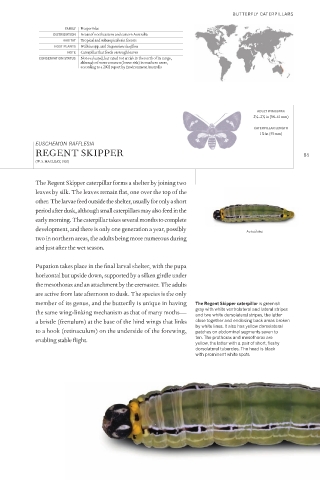
            member of its genus, and the butterfly is unique in having   The Regent Skipper caterpillar is greenish
            the same wing-linking mechanism as that of many moths—  gray with white ventrolateral and lateral stripes
                                                               and two white dorsolateral stripes, the latter
            a bristle (frenulum) at the base of the hind wings that links   close together and enclosing back areas broken
            to a hook (retinaculum) on the underside of the forewing,   by white lines. It also has yellow dorsolateral
                                                               patches on abdominal segments seven to
            enabling stable flight.                             ten. The prothorax and mesothorax are

                                                               yellow, the latter with a pair of short,   eshy
                                                               dorsolateral tubercles. The head is black
                                                               with prominent white spots.

