


Page 88 - The Book of Caterpillars: A Life-Size Guide to Six Hundred Species From Around the World
P. 88
BUTTERFLY CATERPILLARS

                                                     FAMILY  Hesperiidae
                                                 DISTRIBUTION  The Andes of Venezuela, Colombia, Ecuador, Peru, and Bolivia
                                                    HABITAT  Humid Andean cloud forests, especially where bamboo abounds
                                                  HOST PLANTS  Bamboo (Chusquea spp.)
                                                      NOTE  Skipper caterpillar that has unusually weak frass-throwing skills
                                             CONSERVATION STATUS  Not evaluated, but unlikely to become endangered


            ADULT WINGSPAN
           1⁷∕₁₆–1½ in (36–38 mm)
           CATERPILLAR LENGTH
           1¹∕₁₆–1³∕₁₆ in (27–30 mm)
                                                                                FALGA JECONIA
                                                                  FALGA JECONIA
    86
                                                                                    (BUTLER, 1870)


                                            Like the larvae of other skippers, the caterpillars of Falga jeconia
                                            build and inhabit tentlike shelters made from their host plant
                                            leaves. The larvae use their anal comb to fling frass away from

                                            their leafy abodes—as a form of shelter sanitation and possibly

                      Actual size           to put predators off the scent. The only detailed natural history
                                            study of F. jeconia found that, although the caterpillars have
                                            weak frass-throwing abilities, they are found almost exclusively
                                            over mountain streams. The fascinating possibility that this
                                            species uses mountain streams as their natural sewer system
                                            has yet to be explored.


                                            The natural histories of the three additional species included
                                            within the genus Falga are completely unknown, and the yellow
                                            and black adults are generally poorly represented in collections.
                                            Indeed, even at locations where their caterpillars may be found
                                            by the thousands, adults are rarely seen, although the reasons
                                            for this are poorly understood.


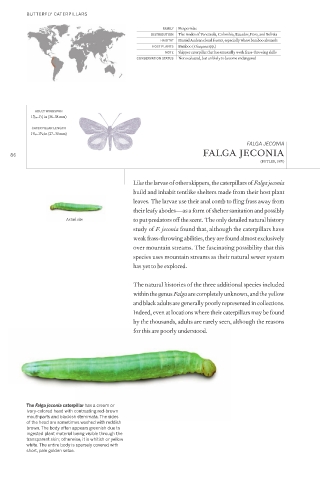
         The Falga jeconia caterpillar has a cream or
         ivory-colored head with contrasting red-brown
         mouthparts and blackish stemmata. The sides
         of the head are sometimes washed with reddish
         brown. The body often appears greenish due to
         ingested plant material being visible through the
         transparent skin; otherwise, it is whitish or yellow
         white. The entire body is sparsely covered with
         short, pale golden setae.

