


Page 89 - The Book of Caterpillars: A Life-Size Guide to Six Hundred Species From Around the World
P. 89
BUTTERFLY CATERPILLARS
FAMILY Hesperiidae
DISTRIBUTION Southern Europe (Portugal, Spain, Italy, Greece, and Bulgaria),
North Africa, Turkey, the Middle East, and southern Asia
east to India
HABITAT Hot, arid areas, including deserts, but also seasonal riverbeds,
coastal areas, and dunes
HOST PLANTS Grasses, including Aeluropus spp. and Panicum spp.
NOTE Arid-zone caterpillar that lives on dry grasses
CONSERVATION STATUS Not evaluated, but usually uncommon
ADULT WINGSPAN
1⁄–1¼ in (30–32 mm)
CATERPILLAR LENGTH
⁄–⅞ in (18–22 mm)
GEGENES NOSTRODAMUS
DINGY SWIFT 87
(FABRICIUS, 1793)
Dingy Swift caterpillars hatch from eggs laid singly on the grass
host plants seven to ten days earlier by the female butterfly.
The larvae silk together grass blades to form a tube within
which they feed and rest, enabling them to avoid detection by
most predators. Their development takes three to six weeks, Actual size
according to temperature, and pupation occurs within a silked-
together grass tube. There are two to three generations from
May to October, and the species overwinters as a caterpillar.
In the most southerly parts of the species’ range, generations
occur throughout the year.
Adult Dingy Swifts are fast-flying skipper butterflies and easily
missed but fortunately have the habit of returning to the same
spot for perching, so patient watching is usually rewarded.
Because of the inconspicuous nature of the species, individuals
may have been overlooked, and their geographic range may
be greater than currently known. There are four species in the
genus Gegenes; G. nostrodamus was the first to be described.
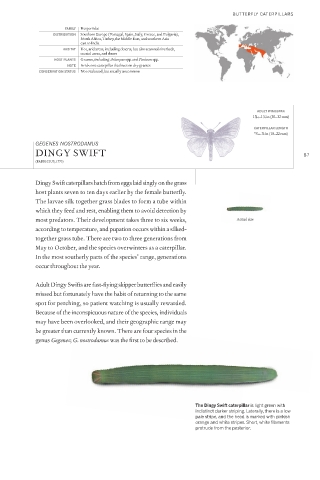
The Dingy Swift caterpillar is light green with
indistinct darker striping. Laterally, there is a low
pale stripe, and the head is marked with pinkish
orange and white stripes. Short, white laments
protrude from the posterior.

