


Page 90 - The Book of Caterpillars: A Life-Size Guide to Six Hundred Species From Around the World
P. 90
BUTTERFLY CATERPILLARS

                                                     FAMILY  Hesperiidae
                                                 DISTRIBUTION  Western United States, west of the Rockies, from Washington
                                                          State to northern Mexico
                                                    HABITAT  Riverbanks, roadsides, and canyons in arid country
                                                  HOST PLANTS  Mallows, including Common Mallow (Malva sylvestris),
                                                          Cheeseweed (Malva parvi ora), and Hollyhock (Althaea rosea)

                                                      NOTE  Nocturnal-feeding, nest-building, green caterpillar
                                             CONSERVATION STATUS  Not evaluated, but usually common


            ADULT WINGSPAN
           1¾–2 in (45–50 mm)
           CATERPILLAR LENGTH
           1–1⅛ in (25–28 mm)
                                                                        HELIOPETES ERICETORUM
                                              NORTHERN WHITE SKIPPER
    88
                                                                                  (BOISDUVAL, 1852)


                                            Northern White Skipper caterpillars hatch from eggs laid singly
                                            during summer on the underside of terminal leaves of the host
                                            plant. Development from egg-laying to pupation takes about
                                            seven weeks, with the pupal period lasting up to four weeks,
                                            even under warm conditions. Early instars hide in the furls of
                                            young terminal leaves of mallows and construct small, folded
                                            leaf nests silked together at the leaf edges. These instars feed
                                            halfway through leaves, creating “window panes,” with round
                                            holes produced later as the larvae mature. Nests become larger as

                                            the caterpillars grow, with pupation taking place in the final nest.

                                            Feeding is mostly nocturnal, and larvae shoot frass away
                                            from themselves to confuse enemies. Predation by pirate bugs

                                            (Anthocoridae) is common, however. The fast-flying, relatively
                                            large skipper adults may undertake seasonal migrations in spring
                                            and fall. The males are often seen sipping moisture from muddy

                                            patches, while females are frequently spotted on flowers.


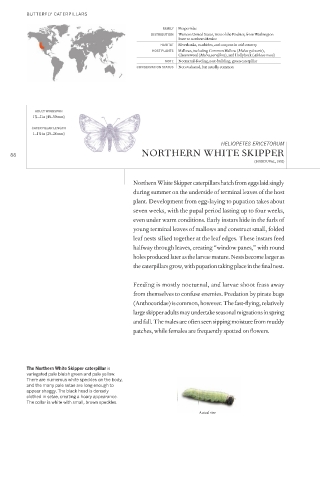
          The Northern White Skipper caterpillar is
          variegated pale bluish green and pale yellow.
          There are numerous white speckles on the body,
          and the many pale setae are long enough to
          appear shaggy. The black head is densely
          clothed in setae, creating a hoary appearance.
          The collar is white with small, brown speckles.
                                                                 Actual size

