


Page 91 - The Book of Caterpillars: A Life-Size Guide to Six Hundred Species From Around the World
P. 91
BUTTERFLY CATERPILLARS
FAMILY Hesperiidae
DISTRIBUTION Western North America, from British Columbia and Alberta
south to New Mexico
HABITAT Grassland prairies to mountain meadows
HOST PLANTS Grasses, including brome (Bromus spp.), ryegrass (Lolium spp.),
and bluestem grass (Andropogon spp.)
NOTE Caterpillar whose prepupal dormancy protects the adult
from extreme heat
CONSERVATION STATUS Not evaluated, but common in most areas
ADULT WINGSPAN
1–1⁄ in (25–30 mm)
CATERPILLAR LENGTH
1⁄–1¼ in (30–32 mm)
HESPERIA COLORADO
WESTERN BRANDED SKIPPER 89
(SCUDDER, 1874)
Western Branded Skipper eggs are laid singly at the base of
grasses and on nearby surfaces. The eggs generally remain
dormant and overwinter, although some hatch into first instars,
which then overwinter, protected by a few strands of silk. The
caterpillars develop in spring, and in early summer reach the final
instar, when they stop feeding and remain dormant for between
four and six weeks before pupating. The late instar dormancy
appears to be a mechanism for avoiding adult emergence in hot
conditions. The adults eclose in late summer to early fall.
The Hesperia colorado caterpillar may have five or six instars
and lives in untidy tubular grass nests comprised of blades
silked together. Pupation takes place in a silken cocoon within
the final nest. The cocoon is liberally decorated with flocculent
material produced by ventral abdominal glands, which appears
to be a way of repelling moisture. Caterpillar defense is based on
concealment, although pirate bugs (Anthocoridae) often invade
the nests to attack the larvae.
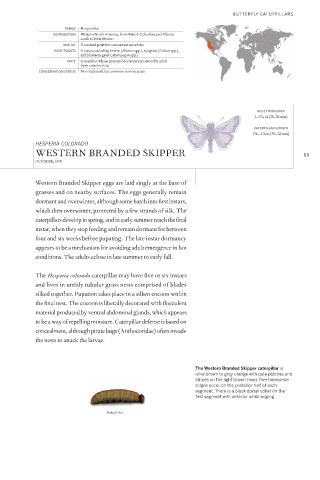
The Western Branded Skipper caterpillar is
olive brown to gray orange with pale patches and
stripes on the light brown head. Five transverse
ridges occur on the posterior half of each
segment. There is a black dorsal collar on the
rst segment with anterior white edging.
Actual size

