


Page 92 - The Book of Caterpillars: A Life-Size Guide to Six Hundred Species From Around the World
P. 92
BUTTERFLY CATERPILLARS
FAMILY Hesperiidae
DISTRIBUTION Southern Canada, northern United States, Eurasia,
and North Africa
HABITAT Alpine meadows and grasslands
HOST PLANTS Sheeps Fescue (Festuca ovina)
NOTE Slow-developing caterpillar that builds grass nests
CONSERVATION STATUS Not evaluated, but vulnerable and threatened in some locations
ADULT WINGSPAN
1–1⁄ in (25–30 mm)
CATERPILLAR LENGTH
1⁄–1¼ in (30–32 mm)
HESPERIA COMMA
COMMON BRANDED SKIPPER
90
(LINNAEUS, 1758)
Common Branded Skipper caterpillars hatch in spring from
overwintering eggs laid singly on grasses or on nearby surfaces.
The larvae eat the tops of the eggs, leaving the remainder intact,
and then feed on the edges of grass blades. Development from
first to sixth instar in North American populations takes only
four weeks, with the sixth instar entering dormancy for about
two and a half months during summer. This dormancy is a
mechanism to avoid adult emergence in hot conditions and may
not occur in cooler northern habitats, for example in England,
where the species is known as the Silver-spotted Skipper.
Grass blades silked together are used as nests throughout
development, with increasing complexity in each successive
instar. Frass is generally stored within shelters, not flung out as
is the case with some other skipper caterpillars. Pupation takes
place in a silken cocoon within the final larval nest lined with a
flocculent material produced by ventral abdominal glands.
Actual size
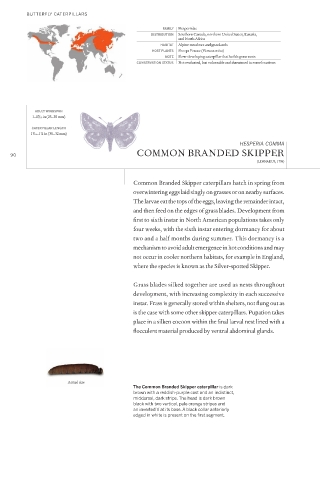
The Common Branded Skipper caterpillar is dark
brown with a reddish-purple cast and an indistinct,
middorsal, dark stripe. The head is dark brown
black with two vertical, pale orange stripes and
an inverted V at its base. A black collar anteriorly
edged in white is present on the rst segment.

