


Page 93 - The Book of Caterpillars: A Life-Size Guide to Six Hundred Species From Around the World
P. 93
BUTTERFLY CATERPILLARS
FAMILY Hesperiidae
DISTRIBUTION Western North America, from British Columbia to New Mexico
HABITAT Sageland, canyons, and xeric grasslands
HOST PLANTS Grasses, including brome (Bromus spp.), meadow grass
(Poa spp.), and needle grass (Stipa spp.)
NOTE Caterpillar that becomes dormant in summer heat
CONSERVATION STATUS Not evaluated, but usually common
ADULT WINGSPAN
1⅜–1⁄ in (35–37 mm)
CATERPILLAR LENGTH
1⁄–1¼ in (30–32 mm)
HESPERIA JUBA
JUBA SKIPPER 91
(SCUDDER, 1874)
The adult female Juba Skipper lays her eggs singly on
inflorescences of dead grasses or at the base of grasses, and
sometimes on soil and other substrates. Caterpillars generally
hatch from the eggs after ten days, although eggs laid in
late fall will overwinter. Some first and second instar larvae
also overwinter. Development is completed in early spring,
and the first generation of adults fly in April to May. Caterpillars
of the second generation develop quickly until the fifth instar,
which then enters summer dormancy, resting in silken grass
shelters and not feeding. Second-generation adults emerge
in late August to September.
Larval defense is based on concealment, although pirate bugs
(Anthocoridae) often enter nests and kill larvae. Pupation occurs
in the final larval nest in a silken, flocculent-lined, moisture-
repelling cocoon. The adult Juba Skipper is commonly seen
feeding on various flower blooms in spring and fall, with males
sometimes imbibing moisture from damp soil.
Actual size
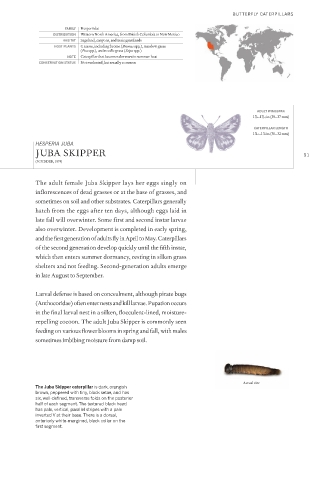
The Juba Skipper caterpillar is dark, orangish
brown, peppered with tiny, black setae, and has
six, well-de ned, transverse folds on the posterior
half of each segment. The textured black head
has pale, vertical, parallel stripes with a pale
inverted V at their base. There is a dorsal,
anteriorly white-margined, black collar on the
rst segment.

