Page 94 - The Book of Caterpillars: A Life-Size Guide to Six Hundred Species From Around the World
P. 94
BUTTERFLY CATERPILLARS

                                                     FAMILY  Hesperiidae
                                                 DISTRIBUTION
                                                 DIS TRIBUTION  Eastern Australia
                                                 DISTRIBUTION
                                                    HABITAT
                                                    HABITAT T  Gullies and swamps, where the host plant occurs as a
                                                    HABIT
                                                       A
                                                          dense understory
                                                  HOST PLANTS
                                                    T PLANT
                                                  HOST PLANTS S  Tall Saw-sedge (Gahnia clarkei)
                                                  HOS
                                                      NOTE
                                                      NOTE  Caterpillar that occurs in colonies, often several per sedge clump
                                                       TE
                                                      NO
                                             CONSERVATION STATUS  Not evaluated, but locally common in suitable habitat
                                             CONSERV
                                             CONSERVATION STATUS
                                                  TION S
                                                      TUS
                                                      A
                                                     T
                                                 A
            ADULT WINGSPAN
           1¼–1⁄ in (32–36 mm)
           CATERPILLAR LENGTH
             1⁄ in (39 mm)
                                                                             HESPERILLA PICTA
                                                  PAINTED SEDGE-SKIPPER
    92
                                                                                     (LEACH, 1814)
                                            The Painted Sedge-skipper caterpillar constructs a loose,
                                            cylindrical, vertical shelter in young foliage near the top of
                                            sedge. The larva rests in the shelter during the day and emerges
                                            at night to feed at the end of the leaves. The larvae overwinter

                                            when small. Pupation occurs in the final larval shelter, usually
                                            a loose structure high in the plant, close to a stem, and with an
                                            opening at the top. The pupa, like the caterpillar, is vertical, with
                                            the head up. There are no more than two generations a year.


                                            The genus contains 13 species, all endemic to the Australian
                                            fauna region, with caterpillars of all species feeding on sedges.
                                            The colorful, fast-flying adults feed at flowers but bask
                                            on the sedge in sunlit areas with their wings partially open.
                                            They generally stay close to their breeding areas, where their
                                            caterpillar food plants form dense stands in tall, open forests.


                        Actual size


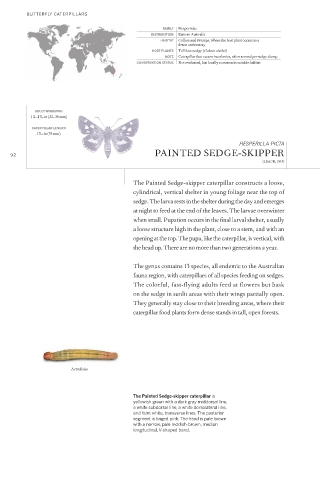
                                            The Painted Sedge-skipper caterpillar is
                                            yellowish green with a dark gray middorsal line,
                                            a white subdorsal line, a white dorsolateral line,
                                            and faint white, transverse lines. The posterior
                                            segment is tinged pink. The head is pale brown
                                            with a narrow, pale reddish-brown, median
                                            longitudinal, V-shaped band.
   89   90   91   92   93   94   95   96   97   98   99