


Page 95 - The Book of Caterpillars: A Life-Size Guide to Six Hundred Species From Around the World
P. 95
BUTTERFLY CATERPILLARS
FAMILY Hesperiidae
DISTRIBUTION Southeastern United States, west to Arizona, south through
Mexico and Central America to Colombia and Venezuela
HABITAT Forest edges and clearings
HOST PLANTS Various grasses, including St. Augustine Grass (Stenotaphrum
secundatum), Silver Plumegrass (Erianthus alopecuroides),
Corn (Zea mays), Echinochloa povietianum, and Sorghum spp.
NOTE Cryptic larva that hides inside a rolled grass leaf
CONSERVATION STATUS Not evaluated, but common
ADULT WINGSPAN
1¼–1¾ in (32–45 mm)
CATERPILLAR LENGTH
1⁄–2 in (40–50 mm)
LEREMA ACCIUS
CLOUDED SKIPPER 93
(J. E. SMITH, 1797)
The Clouded Skipper caterpillar, a minor pest of corn and
other economically important grasses, hatches from eggs laid
singly on the host plant and consumes the empty eggshell.
To construct a shelter, it makes a groove in the side of the leaf,
causing it to curl, then connects its edges using silk threads
to create a tube. The mature caterpillar uses the entire length
of the leaf, fastening it into a tube with six or seven silk bands.
By day, the caterpillar stays inside, sometimes feeding on the
ends of the tube. At night, it ventures out and may eat its own
tube and other leaves as well. If its feeding causes too much
damage to its shelter, the caterpillar makes a new one.
When crawling, the caterpillar moves its head from side to side,
laying down silk fibers, as it is unable to cling to the naked leaf
surface. It ejects frass, expelling it some distance—a strategy
designed to mislead parasitic wasps and predators, which use
the scent of frass to locate their victims. While this species is
probably tropical in origin, its northern limit changes with the
climate; adults fly north during the summer.
Actual size
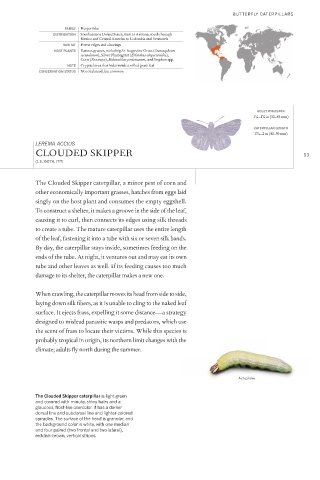
The Clouded Skipper caterpillar is light green
and covered with minute, shiny hairs and a
glaucous, frost-like overcolor. It has a darker
dorsal line and subdorsal line and lighter-colored
spiracles. The surface of the head is granular, and
the background color is white, with one median
and four paired (two frontal and two lateral),
reddish-brown, vertical stripes.

