


Page 24 - (DK) Eyewitness - Mars
P. 24
Three ages of Mars                                                    2                            Noachian Age

                                                                                                            water
                                                                                                            vapor from
                                                                              0
        Scientists believe Mars has had three major ages, or                 Elevation (km)  -2  unfrozen soil, water, and rock  evaporation
                                                                                                               ocean
                                                                             -4
        time periods, each lasting many millions of years. These             -6
        ages are named for different geographic areas of Mars.
        The earliest period, the Noachian Age, may have been                 -8     basement rock
        warm and wet, with active volcanoes. The Noachian                     -90    -60   -30  Latitude  30   60    90
                                                                                                  0
        Age corresponds with Noachis Terra, in the south of
        Mars, where the ancient uplands have been battered by                      condensation on polar cap  Early Hesperian Age
        meteorites. Next is the Hesperian Age, which became                   2    polar layered deposits  frozen   water
        steadily colder, with water freezing. This age is named               0  meltwater           soil,   vapor from
                                                                                                             sublimation
                                                                                                     ice, and
        for the southern hemisphere’s Hesperia Planum, which                 -2  unfrozen soil, water, and rock  rock
        is considered younger because it shows less cratering.               Elevation (km)  -4
        The present era is the Amazonian Age, named for the                  -6
        flat, low Amazonis Planitia of the north. This is a dusty            -8     basement rock            meltwater
        desert region with relatively few craters and is one of               -90   -60    -30    0      30    60    90
        the youngest on Mars.                                                                   Latitude
                                                                                   frozen soil, ice,   Late Hesperian Age
                                                                             2       and rock
        Noachian Mars                                                        0                        catastrophic floods
        The Noachian era probably                                            Elevation (km)  -2
        began about 4.5 billion years                                        -4
        ago when Mars was formed                                                     ground water trapped
        and ended roughly 3.5 billion                                        -6       under high pressure
        years ago. During this period                                        -8   basement rock
        meteorite cratering was
        slowing down. A warmer                                                -90   -60   -30     0     30     60    90
        climate may have permitted                                                              Latitude
        rivers, lakes, and even oceans
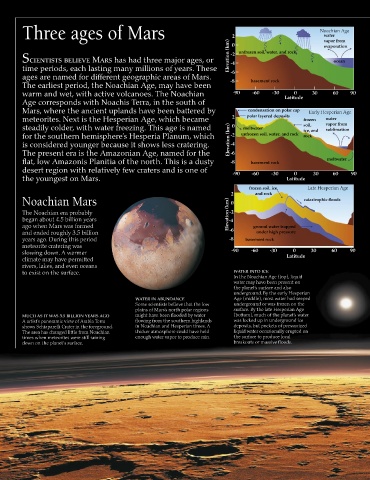
        to exist on the surface.                                              WATER INTO ICE
                                                                              In the Noachian Age (top), liquid
                                                                              water may have been present on
                                                                              the planet’s surface and also
                                                                              underground. By the early Hesperian
                                              WATER IN ABUNDANCE              Age (middle), most water had seeped
                                              Some scientists believe that the low   underground or was frozen on the
                                              plains of Mars’s north polar regions   surface. By the late Hesperian Age
        MUCH AS IT WAS 3.5 BILLION YEARS AGO  might have been flooded by water   (bottom), much of the planet’s water
        A artist’s panoramic view of Arabia Terra   flowing from the southern highlands   was locked up in underground ice
        shows Schiaparelli Crater in the foreground.   in Noachian and Hesperian times. A   deposits, but pockets of pressurized
        The area has changed little from Noachian   thicker atmosphere could have held   liquid water occasionally erupted on
        times when meteorites were still raining   enough water vapor to produce rain.  the surface to produce local
        down on the planet's surface.                                         breakouts or massive floods.

