


Page 25 - (DK) Eyewitness - Mars
P. 25
Hesperian Age

                                                                               The Hesperian era lasted from about 3.5
                                                                               billion years ago to 2.5 billion years ago.
                                                                               Volcanoes rumbled and lava flowed, but
                                                                               volcanic activity slowed down as Mars
                                                                               cooled. Water began freezing, forming ice
                                                                               on the surface and underground. In this
                                                                               time of change, there were probably
                                                                               torrential flash floods, which cut deep, wide
                                                                               channels. As water retreated underground
                                                                               and froze, Mars became drier, making a
                                                                               transition to another age.


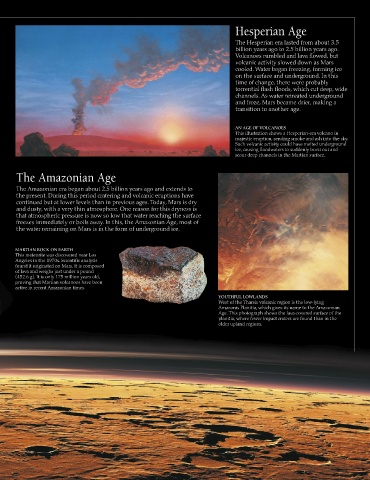
                                                                               AN AGE OF VOLCANOES
                                                                               This illustration shows a Hesperian-era volcano in
                                                                               majestic eruption, sending smoke and ash into the sky.
                                                                               Such volcanic activity could have melted underground
                                                                               ice, causing floodwaters to suddenly burst out and
                                                                               scour deep channels in the Martian surface.


      The Amazonian Age

      The Amazonian era began about 2.5 billion years ago and extends to
      the present. During this period cratering and volcanic eruptions have
      continued but at lower levels than in previous ages. Today, Mars is dry
      and dusty, with a very thin atmosphere. One reason for this dryness is
      that atmospheric pressure is now so low that water reaching the surface
      freezes immediately or boils away. In this, the Amazonian Age, most of
      the water remaining on Mars is in the form of underground ice.


      MARTIAN ROCK ON EARTH
      This meteorite was discovered near Los
      Angeles in the 1970s. Scientific analysis
      found it originated on Mars. It is composed
      of lava and weighs just under a pound
      (452.6 g). It is only 175 million years old,
      proving that Martian volcanoes have been
      active in recent Amazonian times.
                                                                         YOUTHFUL LOWLANDS
                                                                         West of the Tharsis volcanic region is the low-lying
                                                                         Amazonis Planitia, which gives its name to the Amazonian
                                                                         Age. This photograph shows the lava-covered surface of the
                                                                         planitia, where fewer impact craters are found than in the
                                                                         older upland regions.

