


Page 31 - (DK) Eyewitness - Mars
P. 31
Sojourner Rover

      “Six wheels on soil!” cried scientists on Earth
      when Sojourner rolled down its deployment
      ramp and onto Mars. This was the first “robotic
      roving vehicle” ever to explore Mars. The
      name, “Sojourner,” honored the 19th-century
      African-American woman, Sojourner Truth,
      who fought against slavery and for women’s
      rights. NASA’s six-wheeled robotic explorer
      weighed about 24 pounds (11 kg) and was
      equipped with lasers, temperature sensors,
      cameras, telecommunications equipment, and
      tools for analyzing rock and dirt. Moving
      almost two feet (.6 m) a minute, the rover
      studied minerals on the ground and dust in
      the air. NASA scientists collecting Sojourner’s
      data gave names like “Shark,” “Wedge,”
      “Squid,” “Yogi,” and “Chimp” to rocks the
      mission photographed.


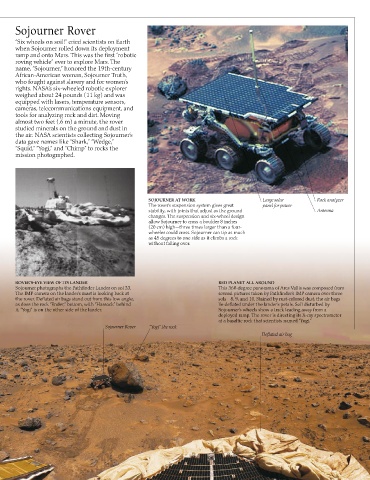
                                                  SOJOURNER AT WORK                     Large solar       Rock analyzer
                                                  The rover’s suspension system gives great   panel for power
                                                  stability, with joints that adjust as the ground        Antenna
                                                  changes. The suspension and six-wheel design
                                                  allow Sojourner to cross a boulder 8 inches
                                                  (20 cm) high—three times larger than a four-
                                                  wheeler could cross. Sojourner can tip as much
                                                  as 45 degrees to one side as it climbs a rock
                                                  without falling over.


      ROVER’S-EYE VIEW OF ITS LANDER                                     RED PLANET ALL AROUND
      Sojourner photographs the Pathfinder Lander on sol 33.             This 360-degree panorama of Ares Vallis was composed from
      The IMP camera on the lander’s mast is looking back at             several pictures taken by Pathfinder’s IMP camera over three
      the rover. Deflated air bags stand out from this low angle,        sols—8, 9, and 10. Stained by rust-colored dust, the air bags
      as does the rock “Ender,” bottom, with “Hassock” behind            lie deflated under the lander’s petals. Soil disturbed by
      it. “Yogi” is on the other side of the lander.                     Sojourner’s wheels show a track leading away from a
                                                                         deployed ramp. The rover is directing its X-ray spectrometer
                                                                         at a basaltic rock that scientists named “Yogi.”
                                    Sojourner Rover  “Yogi” the rock
                                                                                        Deflated air bag

