


Page 32 - (DK) Eyewitness - Mars
P. 32
Mapping Mars


        In the 1960s and 1970s, the Mariner and Viking missions led to
        the first topographic maps of Mars, and in 1997 the success of
        Mars Pathfinder furthered spacecraft technology. Later that
        year, Mars Global Surveyor provided detailed information on
        topography, gravity, and magnetic fields. Global Surveyor is
        NASA’s most successful mapping mission. Yet planetary
        mapmaking involves more than charting mountains and
        canyons. Some scientific instruments used in mapping
        also identify minerals and frozen liquids. NASA’s
        Mars Odyssey orbiter arrived in 2001 to map the
        surface, study minerals, and also look for water—
        which instrument readings suggested was there.
        Next came the European Space Agency’s Mars
        Express orbiter in 2003. While mapping the
        South Polar cap, Mars Express confirmed
        Odyssey's finds of both water ice and carbon
        dioxide ice under the surface.

         Mars Global Surveyor

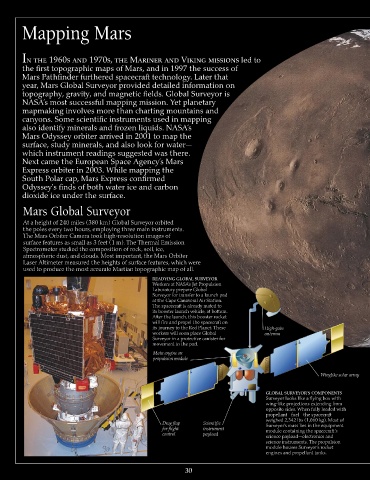
         At a height of 240 miles (380 km) Global Surveyor orbited
         the poles every two hours, employing three main instruments.
         The Mars Orbiter Camera took high-resolution images of
         surface features as small as 3 feet (1 m). The Thermal Emission
         Spectrometer studied the composition of rock, soil, ice,
         atmospheric dust, and clouds. Most important, the Mars Orbiter
         Laser Altimeter measured the heights of surface features, which were
         used to produce the most accurate Martian topographic map of all.
                                                   READYING GLOBAL SURVEYOR
                                                   Workers at NASA’s Jet Propulsion
                                                   Laboratory prepare Global
                                                   Surveyor for transfer to a launch pad
                                                   at the Cape Canaveral Air Station.
                                                   The spacecraft is already mated to
                                                   its booster launch vehicle, at bottom.
                                                   After the launch, this booster rocket
                                                   will fire and propel the spacecraft on
                                                   its journey to the Red Planet. These   High-gain
                                                   workers will soon place Global        antenna
                                                   Surveyor in a protective canister for
                                                   movement to the pad.
                                                    Main engine on
                                                    propulsion module

                                                                                                           Winglike solar array


                                                                                         GLOBAL SURVEYOR’S COMPONENTS
                                                                                         Surveyor looks like a flying box with
                                                                                         wing-like projections extending from
                                                                                         opposite sides. When fully loaded with
                                                                                         propellant—fuel—the spacecraft
                                                                                         weighed 2,342 lbs (1,060 kg). Most of
                                                       Drag flap    Scientific           Surveyor’s mass lies in the equipment
                                                       for flight   instrument           module containing the spacecraft's
                                                       control      payload
                                                                                         science payload—electronics and
                                                                                         science instruments. The propulsion
                                                                                         module houses Surveyor’s rocket
                                                                                         engines and propellant tanks.

                                                              30

