


Page 30 - (DK) Eyewitness - Mars
P. 30
Mars Pathfinder


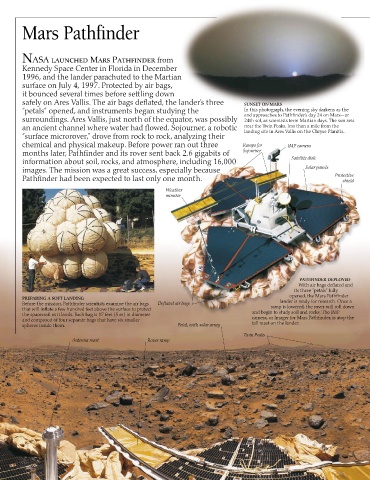
        NASA launched Mars Pathfinder from
        Kennedy Space Center in Florida in December
        1996, and the lander parachuted to the Martian
        surface on July 4, 1997. Protected by air bags,
        it bounced several times before settling down
        safely on Ares Vallis. The air bags deflated, the lander’s three          SUNSET ON MARS
        “petals” opened, and instruments began studying the                       In this photograph, the evening sky darkens as the
        surroundings. Ares Vallis, just north of the equator, was possibly        end approaches to Pathfinder’s day 24 on Mars—or
                                                                                  24th sol, as scientists term Martian days. The sun sets
        an ancient channel where water had flowed. Sojourner, a robotic           near the Twin Peaks, less than a mile from the
                                                                                  landing site in Ares Vallis on the Chryse Planitia.
        “surface microrover,” drove from rock to rock, analyzing their
        chemical and physical makeup. Before power ran out three                 Ramps for      IMP camera
        months later, Pathfinder and its rover sent back 2.6 gigabits of         Sojourner
        information about soil, rocks, and atmosphere, including 16,000                          Satellite dish
        images. The mission was a great success, especially because                                   Solar panels
        Pathfinder had been expected to last only one month.                                                    Protective
                                                                                                                  shield
                                                        Weather
                                                        monitor


                                                                                                    PATHFINDER DEPLOYED
                                                                                                    With air bags deflated and
                                                                                                  its three “petals” fully
                                                                                                 opened, the Mars Pathfinder
        PREPARING A SOFT LANDING
        Before the mission, Pathfinder scientists examine the air bags   Deflated air bags    lander is ready for research. Once a
        that will inflate a few hundred feet above the surface to protect                  ramp is lowered, the rover will roll down
        the spacecraft as it lands. Each bag is 17 feet (5 m) in diameter           and begin to study soil and rocks. The IMP
        and composed of four separate bags that have six smaller                    camera, or Imager for Mars Pathfinder, is atop the
        spheres inside them.                                Petal, with solar array  tall mast on the lander.
                                                                                  Twin Peaks
                         Antenna mast             Rover ramp

