


Page 29 - (DK) Eyewitness - Mars
P. 29
Discoverer of the moons

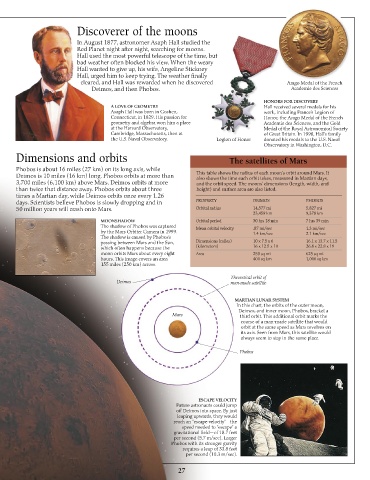
                           In August 1877, astronomer Asaph Hall studied the
                           Red Planet night after night, searching for moons.
                           Hall used the most powerful telescope of the time, but
                           bad weather often blocked his view. When the weary
                           Hall wanted to give up, his wife, Angeline Stickney
                           Hall, urged him to keep trying. The weather finally
                            cleared, and Hall was rewarded when he discovered                   Arago Medal of the French
                               Deimos, and then Phobos.                                          Academie des Sciences
                                                                                        HONORS FOR DISCOVERY
                                      A LOVE OF GEOMETRY                                Hall received several medals for his
                                      Asaph Hall was born in Goshen,                    work, including France’s Legion of
                                      Connecticut, in 1829. His passion for             Honor, the Arago Medal of the French
                                      geometry and algebra won him a place              Academie des Sciences, and the Gold
                                      at the Harvard Observatory,                       Medal of the Royal Astronomical Society
                                      Cambridge, Massachusetts, then at                 of Great Britain. In 1998, Hall’s family
                                      the U.S. Naval Observatory.        Legion of Honor  donated his medals to the U.S. Naval
                                                                                        Observatory in Washington, D.C.
      Dimensions and orbits                                                  The satellites of Mars

      Phobos is about 16 miles (27 km) on its long axis, while
      Deimos is 10 miles (16 km) long. Phobos orbits at more than   This table shows the radius of each moon’s orbit around Mars. It
                                                                  also shows the time each orbit takes, measured in Martian days,
      3,700 miles (6,100 km) above Mars. Deimos orbits at more    and the orbit speed. The moons’ dimensions (length, width, and
      than twice that distance away. Phobos orbits about three    height) and surface area are also listed.
      times a Martian day, while Deimos orbits once every 1.26
      days. Scientists believe Phobos is slowly dropping and in   PROPERTY           DEIMOS           PHOBOS
      50 million years will crash onto Mars.                      Orbital radius     14,577 mi        5,827 mi
                                                                                     23,459 km        9,378 km
                                  MOONSHADOW                      Orbital period     30 hrs 18 min    7 hrs 39 min
                                  The shadow of Phobos was captured   Mean orbital velocity   .87 mi/sec   1.3 mi/sec
                                  by the Mars Orbiter Camera in 1999.                1.4 km/sec       2.1 km/sec
                                  The shadow is caused by Phobos’s
                                  passing between Mars and the Sun,   Dimensions (miles)   10 x 7.5 x 6   16.1 x 13.7 x 11.5
                                  which often happens because the   (kilometers)     16 x 12.5 x 10   26.8 x 22.8 x 19
                                  moon orbits Mars about every eight   Area          250 sq mi        625 sq mi
                                  hours. This image covers an area                   400 sq km        1,000 sq km
                                  155 miles (250 km) across.

                                                                             Theoretical orbit of
                                        Deimos                               man-made satellite


                                                                               MARTIAN LUNAR SYSTEM
                                                                               In this chart, the orbits of the outer moon,
                                                                                Deimos, and inner moon, Phobos, bracket a
                                                          Mars                  third orbit. This additional orbit marks the
                                                                                 course of a man-made satellite that would
                                                                                 orbit at the same speed as Mars revolves on
                                                                                 its axis. Seen from Mars, this satellite would
                                                                                 always seem to stay in the same place.

                                                                                Phobos


                                                                   ESCAPE VELOCITY
                                                           Future astronauts could jump
                                                           off Deimos into space. By just
                                                            leaping upwards, they would
                                                          reach an “escape velocity”—the
                                                             speed needed to “escape” a
                                                          gravitational field—of 18.7 feet
                                                           per second (5.7 m/sec). Larger
                                                          Phobos with its stronger gravity
                                                             requires a leap of 33.8 feet
                                                               per second (10.3 m/sec).

                                                            2

