


Page 269 - (DK) Ocean - The Definitive Visual Guide
P. 269
CNIDARIANS        267


                CLASS ANTHOZOA                CLASS ANTHOZOA                                             CLASS ANTHOZOA
                                                                          ARMORED
             Plumose Anemone               Cloak Anemone                  VEHICLE                     Antarctic Anemone

             Metridium senile              Adamsia palliata                                           Urticinopsis antarctica
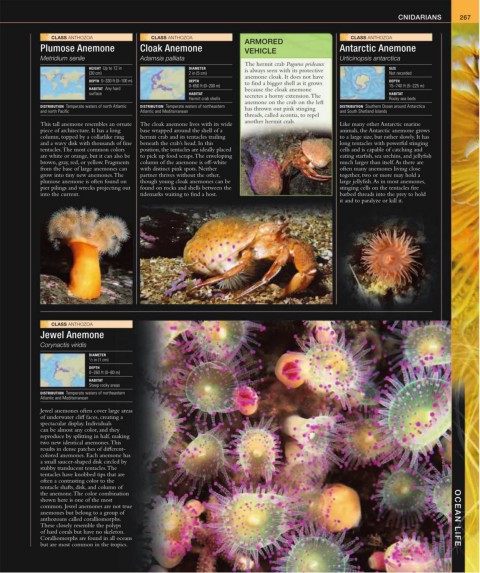
                                                                          The hermit crab Pagurus prideaux
                           HEIGHT  Up to 12 in           DIAMETER         is always seen with its protective         SIZE
                           (30 cm)                       2 in (5 cm)                                                 Not recorded
                                                                          anemone cloak. It does not have
                           DEPTH  0–330 ft (0–100 m)     DEPTH                                                       DEPTH
                                                         0–650 ft (0–200 m)  to find a bigger shell as it grows      15–740 ft (5–225 m)
                           HABITAT  Any hard                              because the cloak anemone
                           surface                       HABITAT                                                     HABITAT
                                                         Hermit crab shells  secretes a horny extension. The         Rocky sea beds
                                                                          anemone on the crab on the left
             DISTRIBUTION  Temperate waters of north Atlantic   DISTRIBUTION  Temperate waters of northeastern   DISTRIBUTION  Southern Ocean around Antarctica
             and north Pacific              Atlantic and Mediterranean     has thrown out pink stinging   and South Shetland Islands
                                                                          threads, called acontia, to repel
                                                                          another hermit crab.
             This tall anemone resembles an ornate   The cloak anemone lives with its wide            Like many other Antarctic marine
             piece of architecture. It has a long   base wrapped around the shell of a                animals, the Antarctic anemone grows
             column, topped by a collarlike ring   hermit crab and its tentacles trailing             to a large size, but rather slowly. It has
             and a wavy disk with thousands of fine   beneath the crab’s head. In this                long tentacles with powerful stinging
             tentacles. The most common colors   position, the tentacles are ideally placed           cells and is capable of catching and
             are white or orange, but it can also be   to pick up food scraps. The enveloping         eating starfish, sea urchins, and jellyfish
             brown, gray, red, or yellow. Fragments   column of the anemone is off-white              much larger than itself. As there are
             from the base of large anemones can   with distinct pink spots. Neither                  often many anemones living close
             grow into tiny new anemones. The   partner thrives without the other,                    together, two or more may hold a
             plumose anemone is often found on   though young cloak anemones can be                   large jellyfish. As in most anemones,
             pier pilings and wrecks projecting out   found on rocks and shells between the           stinging cells on the tentacles fire
             into the current.             tidemarks waiting to find a host.                          barbed threads into the prey to hold
                                                                                                      it and to paralyze or kill it.


                CLASS ANTHOZOA
             Jewel Anemone

             Corynactis viridis
                           DIAMETER
                           1 / 2  in (1 cm)
                           DEPTH
                           0–260 ft (0–80 m)
                           HABITAT
                           Steep rocky areas
             DISTRIBUTION  Temperate waters of northeastern
             Atlantic and Mediterranean
             Jewel anemones often cover large areas
             of underwater cliff faces, creating a
             spectacular display. Individuals
             can be almost any color, and they
             reproduce by splitting in half, making
             two new identical anemones. This
             results in dense patches of different-
             colored anemones. Each anemone has
             a small saucer-shaped disk circled by
             stubby translucent tentacles. The
             tentacles have knobbed tips that are
             often a contrasting color to the
             tentacle shafts, disk, and column of
             the anemone. The color combination
             shown here is one of the most
             common. Jewel anemones are not true
             anemones but belong to a group of
             anthozoans called coralliomorphs.                                                                                           OCEAN LIFE
             These closely resemble the polyps
             of hard corals but have no skeleton.
             Coralliomorphs are found in all oceans
             but are most common in the tropics.

