


Page 270 - (DK) Ocean - The Definitive Visual Guide
P. 270
268     ANIMAL LIFE


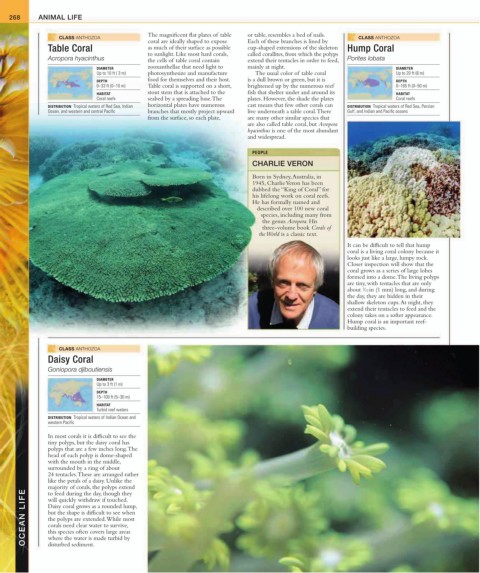
                  CLASS ANTHOZOA             The magnificent flat plates of  table   or table, resembles a bed of nails.    CLASS ANTHOZOA
                                             coral are ideally shaped to expose    Each of these branches is lined by
               Table Coral                   as much of their surface as possible    cup-shaped extensions of the skeleton   Hump Coral
                                             to sunlight. Like most hard corals,    called corallites, from which the polyps
               Acropora hyacinthus           the cells of  table coral contain   extend their tentacles in order to feed,   Porites lobata
                              DIAMETER       zooxanthellae that need light to   mainly at night.                       DIAMETER
                              Up to 10 ft ( 3 m)  photosynthesize and manufacture    The usual color of  table coral    Up to 20 ft (6 m)
                              DEPTH          food for themselves and their host.   is a dull brown or green, but it is   DEPTH
                              0–33 ft (0–10 m)  Table coral is supported on a short,   brightened up by the numerous reef   0–165 ft (0–50 m)
                              HABITAT        stout stem that is attached to the    fish that shelter under and around its   HABITAT
                              Coral reefs    seabed by a spreading base. The   plates. However, the shade the plates   Coral reefs
               DISTRIBUTION  Tropical waters of Red Sea, Indian   horizontal plates have numerous   cast means that few other corals can   DISTRIBUTION  Tropical waters of Red Sea, Persian
               Ocean, and western and central Pacific  branches that mostly project upward   live underneath a table coral. There    Gulf, and Indian and Pacific oceans
                                             from the surface, so each plate,    are many other similar species that
                                                                           are also called table coral, but Acropora
                                                                           hyacinthus is one of the most abundant
                                                                           and widespread.

                                                                            PEOPLE
                                                                            CHARLIE VERON
                                                                            Born in Sydney, Australia, in
                                                                            1945, Charlie Veron has been
                                                                            dubbed the “King of Coral” for
                                                                            his lifelong work on coral reefs.
                                                                            He has formally named and
                                                                              described over 100 new coral
                                                                               species, including many from
                                                                               the genus Acropora. His
                                                                               three-volume book Corals of
                                                                              the World is a classic text.
                                                                                                        It can be difficult to tell that hump
                                                                                                        coral is a living coral colony because it
                                                                                                        looks just like a large, lumpy rock.
                                                                                                        Closer inspection will show that the
                                                                                                        coral grows as a series of large lobes
                                                                                                        formed into a dome. The living polyps
                                                                                                        are tiny, with tentacles that are only
                                                                                                             1
                                                                                                        about / 32 in (1 mm) long, and during
                                                                                                        the day, they are hidden in their
                                                                                                        shallow skeleton cups. At night, they
                                                                                                        extend their tentacles to feed and the
                                                                                                        colony takes on a softer appearance.
                                                                                                        Hump coral is an important reef-
                                                                                                        building species.

                  CLASS ANTHOZOA
               Daisy Coral

               Goniopora djiboutiensis
                              DIAMETER
                              Up to 3 ft (1 m)
                              DEPTH
                              15–100 ft (5–30 m)
                              HABITAT
                              Turbid reef waters
               DISTRIBUTION  Tropical waters of Indian Ocean and
               western Pacific

               In most corals it is difficult to see the
               tiny polyps, but the daisy coral has
               polyps that are a few inches long. The
               head of each polyp is dome-shaped
               with the mouth in the middle,
               surrounded by a ring of about
               24 tentacles. These are arranged rather
               like the petals of a daisy. Unlike the
               majority of corals, the polyps extend
        OCEAN LIFE  Daisy coral grows as a rounded lump,
               to feed during the day, though they
               will quickly withdraw if touched.
               but the shape is difficult to see when
               the polyps are extended. While most
               corals need clear water to survive,
               this species often covers large areas
               where the water is made turbid by
               disturbed sediment.

