


Page 312 - (DK) Ocean - The Definitive Visual Guide
P. 312
310 ANIMAL LIFE
CLASS ECHINOIDEA Sand Dollars are sea urchins that have CLASS ECHINOIDEA
become extremely flattened as an
Sand Dollar adaptation for burrowing through Flower Urchin
sand. A mat of very fine spines covers
Echinodiscus auritus the shell, or test, and the pattern of the Toxopneustes pileolus
DIAMETER animal’s skeleton plates can often be DIAMETER
Up to 11cm (4in) seen through the skin. The mouth is Up to 15cm (6in)
DEPTH on the underside. At the rear are two DEPTH
0–50m (0–165ft) notches that open at the margins of 0–90m (0–300ft)
HABITAT the test, and water currents passing HABITAT
Clean sand through these slits are thought to help Sand, rubble, rocky reef
DISTRIBUTION Tropical and warm waters of Indian to push the urchin down and prevent DISTRIBUTION Tropical waters of Indian Ocean,
Ocean, Red Sea, western Pacific it being swept away. central and western Pacific Ocean
This species is extremely venomous but will sting animals that touch it.
CLASS ECHINOIDEA Many divers on coral reefs have learnt and has caused rare fatalities. It has The pedicellariae also hold pieces of
to avoid these sea urchins. They bristle short, inconspicuous spines through shell, rubble, and seaweed that shade
Long-spined Sea with long, sharp spines that can easily which emerge an array of flower-like the urchin from sunlight. Flower
Urchin wound, even through a wetsuit. The appendages called pedicellariae. These Urchins may partially bury themselves,
despite having few predators.
help to keep the urchin’s surface clean
spines are mildly venomous and so
brittle that they may break off in the
Diadema savignyi
wound. If a diver or predator comes
DIAMETER Up to 23cm near to it, this sea urchin waves its
(9in) CLASS ECHINOIDEA
spines about vigorously. Only a few
DEPTH 0–70m (0–230ft) tough fish, such as the Titan Triggerfish, Edible Sea Urchin
HABITAT Coral and rocky can successfully attack and eat such
reefs prickly prey. This species often has Echinus esculentus
striped spines, while the other common DIAMETER
DISTRIBUTION Tropical waters of Indian and western Indo-Pacific long-spined species, Up to 16cm (6in)
Pacific oceans
Diadema setosum, has black spines. DEPTH
0–50m (0–160ft)
HABITAT
Rocky areas
DISTRIBUTION Temperate waters of northeastern
Atlantic
This large, spherical urchin is covered
with uniform short spines that give
it the appearance of a fat hedgehog.
It is generally a pinkish colour, with
pairs of darker, radiating lines where
its numerous tube feet emerge. These
urchins are important grazers and can
have much the same effect underwater
as rabbits do on land, leaving the rocks
covered only in hard pink encrusting
algae. As their name suggests, the roe
of this species can be eaten.
CLASS ECHINOIDEA
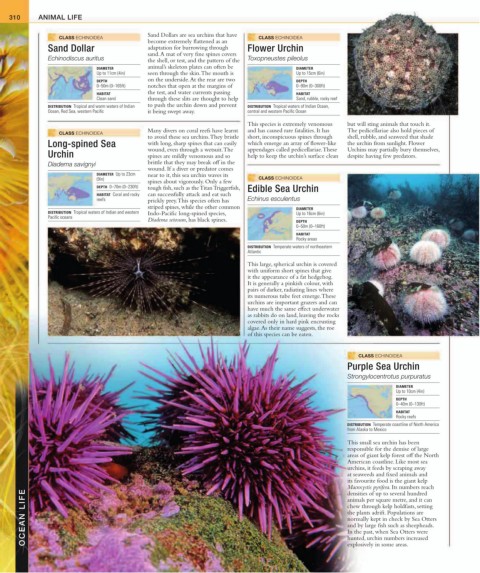
Purple Sea Urchin
Strongylocentrotus purpuratus
DIAMETER
Up to 10cm (4in)
DEPTH
0–40m (0–130ft)
HABITAT
Rocky reefs
DISTRIBUTION Temperate coastline of North America
from Alaska to Mexico
This small sea urchin has been
responsible for the demise of large
areas of giant kelp forest off the North
American coastline. Like most sea
urchins, it feeds by scraping away
at seaweeds and fixed animals and
its favourite food is the giant kelp
Macrocystis pyrifera. Its numbers reach
OCEAN LIFE chew through kelp holdfasts, setting
densities of up to several hundred
animals per square metre, and it can
the plants adrift. Populations are
normally kept in check by Sea Otters
and by large fish such as sheepheads.
In the past, when Sea Otters were
hunted, urchin numbers increased
explosively in some areas.

