


Page 270 - Applied Statistics with R
P. 270
270                             CHAPTER 13. MODEL DIAGNOSTICS


                                                            Data from Model 3


                                       30
                                       20

                                   Residuals  10  0


                                       -10

                                       -20


                                          -20      0      20       40      60      80      100

                                                                   Fitted


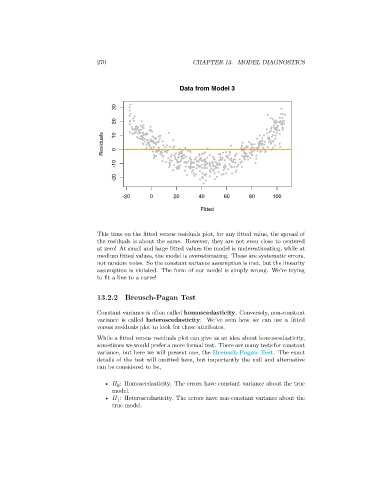
                                 This time on the fitted versus residuals plot, for any fitted value, the spread of
                                 the residuals is about the same. However, they are not even close to centered
                                 at zero! At small and large fitted values the model is underestimating, while at
                                 medium fitted values, the model is overestimating. These are systematic errors,
                                 not random noise. So the constant variance assumption is met, but the linearity
                                 assumption is violated. The form of our model is simply wrong. We’re trying
                                 to fit a line to a curve!


                                 13.2.2   Breusch-Pagan Test

                                 Constant variance is often called homoscedasticity. Conversely, non-constant
                                 variance is called heteroscedasticity. We’ve seen how we can use a fitted
                                 versus residuals plot to look for these attributes.
                                 While a fitted versus residuals plot can give us an idea about homoscedasticity,
                                 sometimes we would prefer a more formal test. There are many tests for constant
                                 variance, but here we will present one, the Breusch-Pagan Test. The exact
                                 details of the test will omitted here, but importantly the null and alternative
                                 can be considered to be,

                                    •    : Homoscedasticity. The errors have constant variance about the true
                                        0
                                      model.
                                    •    : Heteroscedasticity. The errors have non-constant variance about the
                                        1
                                      true model.

