


Page 273 - Applied Statistics with R
P. 273
13.2. CHECKING ASSUMPTIONS                                        273


                      a rough bell shape, however, it also has a very sharp peak. For this reason we
                      will usually use more powerful tools such as Q-Q plots and the Shapiro-Wilk
                      test for assessing the normality of errors.


                      13.2.4    Q-Q Plots

                      Another visual method for assessing the normality of errors, which is more
                      powerful than a histogram, is a normal quantile-quantile plot, or Q-Q plot for
                      short.
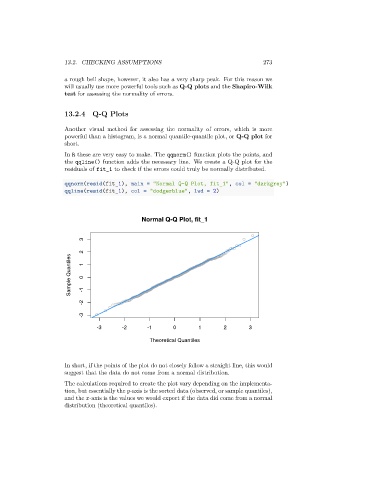
                      In R these are very easy to make. The qqnorm() function plots the points, and
                      the qqline() function adds the necessary line. We create a Q-Q plot for the
                      residuals of fit_1 to check if the errors could truly be normally distributed.

                      qqnorm(resid(fit_1), main = "Normal Q-Q Plot, fit_1", col = "darkgrey")
                      qqline(resid(fit_1), col = "dodgerblue", lwd = 2)


                                                Normal Q-Q Plot, fit_1


                             3

                             2
                        Sample Quantiles  1  0


                             -2  -1
                             -3

                                 -3      -2       -1      0        1       2       3

                                                   Theoretical Quantiles


                      In short, if the points of the plot do not closely follow a straight line, this would
                      suggest that the data do not come from a normal distribution.
                      The calculations required to create the plot vary depending on the implementa-
                      tion, but essentially the   -axis is the sorted data (observed, or sample quantiles),
                      and the   -axis is the values we would expect if the data did come from a normal
                      distribution (theoretical quantiles).

