


Page 272 - Applied Statistics with R
P. 272
272                             CHAPTER 13. MODEL DIAGNOSTICS


                                 Lastly, for fit_3 we again see a large p-value, so we do not reject the null of
                                 homoscedasticity, which matches our findings with a fitted versus residuals plot.


                                 13.2.3   Histograms

                                 We have a number of tools for assessing the normality assumption. The most
                                 obvious would be to make a histogram of the residuals. If it appears roughly
                                 normal, then we’ll believe the errors could truly be normal.

                                 par(mfrow = c(1, 3))
                                 hist(resid(fit_1),
                                      xlab    = "Residuals",
                                      main    = "Histogram of Residuals, fit_1",
                                      col     = "darkorange",
                                      border = "dodgerblue",
                                      breaks = 20)
                                 hist(resid(fit_2),
                                      xlab    = "Residuals",
                                      main    = "Histogram of Residuals, fit_2",
                                      col     = "darkorange",
                                      border = "dodgerblue",
                                      breaks = 20)
                                 hist(resid(fit_3),
                                      xlab    = "Residuals",
                                      main    = "Histogram of Residuals, fit_3",
                                      col     = "darkorange",
                                      border = "dodgerblue",
                                      breaks = 20)


                                         Histogram of Residuals, fit_1  Histogram of Residuals, fit_2  Histogram of Residuals, fit_3
                                   100                                           40
                                                          150
                                   80
                                                                                 30
                                   60                     100
                                  Frequency              Frequency              Frequency  20
                                   40
                                                          50
                                                                                 10
                                   20
                                   0                      0                      0
                                    -3  -2  -1  0  1  2  3  -15  -10  -5  0  5  10  15  -20  -10  0  10  20  30
                                            Residuals              Residuals              Residuals

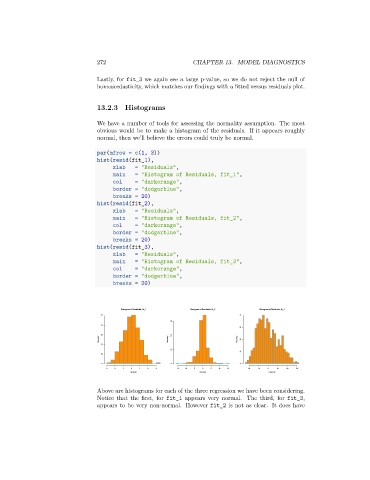
                                 Above are histograms for each of the three regression we have been considering.
                                 Notice that the first, for fit_1 appears very normal. The third, for fit_3,
                                 appears to be very non-normal. However fit_2 is not as clear. It does have

