


Page 329 - Applied Statistics with R
P. 329
14.2. PREDICTOR TRANSFORMATION                                    329


                             300


                             100
                        y

                             -100


                             -300

                                 0         2         4          6         8         10

                                                          x


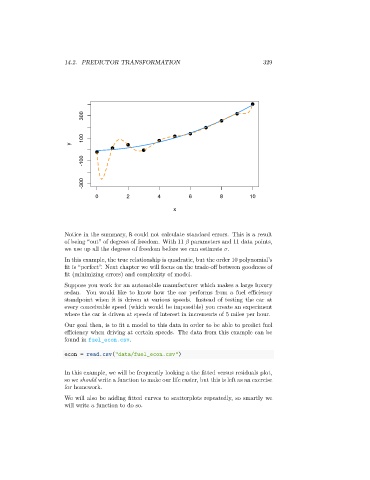
                      Notice in the summary, R could not calculate standard errors. This is a result
                      of being “out” of degrees of freedom. With 11    parameters and 11 data points,
                      we use up all the degrees of freedom before we can estimate   .
                      In this example, the true relationship is quadratic, but the order 10 polynomial’s
                      fit is “perfect”. Next chapter we will focus on the trade-off between goodness of
                      fit (minimizing errors) and complexity of model.
                      Suppose you work for an automobile manufacturer which makes a large luxury
                      sedan. You would like to know how the car performs from a fuel efficiency
                      standpoint when it is driven at various speeds. Instead of testing the car at
                      every conceivable speed (which would be impossible) you create an experiment
                      where the car is driven at speeds of interest in increments of 5 miles per hour.
                      Our goal then, is to fit a model to this data in order to be able to predict fuel
                      efficiency when driving at certain speeds. The data from this example can be
                      found in fuel_econ.csv.

                      econ = read.csv("data/fuel_econ.csv")


                      In this example, we will be frequently looking a the fitted versus residuals plot,
                      so we should write a function to make our life easier, but this is left as an exercise
                      for homework.

                      We will also be adding fitted curves to scatterplots repeatedly, so smartly we
                      will write a function to do so.

