


Page 330 - Applied Statistics with R
P. 330
330                              CHAPTER 14. TRANSFORMATIONS


                                 plot_econ_curve = function(model) {
                                   plot(mpg ~ mph, data = econ, xlab = "Speed (Miles per Hour)",
                                        ylab = "Fuel Efficiency (Miles per Gallon)", col = "dodgerblue",
                                        pch = 20, cex = 2)
                                   xplot = seq(10, 75, by = 0.1)
                                   lines(xplot, predict(model, newdata = data.frame(mph = xplot)),
                                          col = "darkorange", lwd = 2, lty = 1)
                                 }

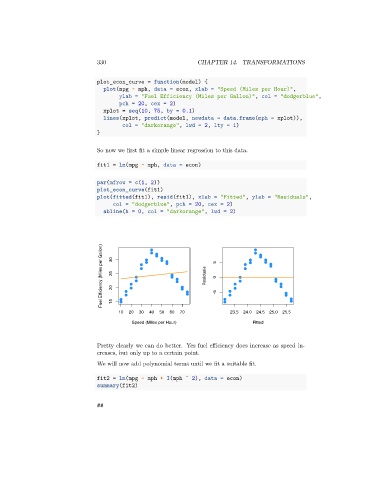
                                 So now we first fit a simple linear regression to this data.

                                 fit1 = lm(mpg ~ mph, data = econ)


                                 par(mfrow = c(1, 2))
                                 plot_econ_curve(fit1)
                                 plot(fitted(fit1), resid(fit1), xlab = "Fitted", ylab = "Residuals",
                                      col = "dodgerblue", pch = 20, cex = 2)
                                   abline(h = 0, col = "darkorange", lwd = 2)


                                   Fuel Efficiency (Miles per Gallon)  30  25  20  Residuals  5  0  -5


                                      15
                                        10  20  30  40  50  60  70           23.5  24.0  24.5  25.0  25.5
                                             Speed (Miles per Hour)                  Fitted


                                 Pretty clearly we can do better. Yes fuel efficiency does increase as speed in-
                                 creases, but only up to a certain point.
                                 We will now add polynomial terms until we fit a suitable fit.

                                 fit2 = lm(mpg ~ mph + I(mph ^ 2), data = econ)
                                 summary(fit2)


                                 ##

