


Page 331 - Applied Statistics with R
P. 331
14.2. PREDICTOR TRANSFORMATION                                    331


                      ## Call:
                      ## lm(formula = mpg ~ mph + I(mph^2), data = econ)
                      ##
                      ## Residuals:
                      ##      Min      1Q  Median       3Q     Max
                      ## -2.8411 -0.9694   0.0017   1.0181  3.3900
                      ##
                      ## Coefficients:
                      ##                Estimate Std. Error t value Pr(>|t|)
                      ## (Intercept)   2.4444505   1.4241091   1.716    0.0984 .
                      ## mph           1.2716937   0.0757321  16.792 3.99e-15 ***
                      ## I(mph^2)     -0.0145014   0.0008719 -16.633 4.97e-15 ***
                      ## ---
                      ## Signif. codes:   0 '***' 0.001 '**' 0.01 '*' 0.05 '.' 0.1 ' ' 1
                      ##
                      ## Residual standard error: 1.663 on 25 degrees of freedom
                      ## Multiple R-squared:   0.9188, Adjusted R-squared:    0.9123
                      ## F-statistic: 141.5 on 2 and 25 DF,    p-value: 2.338e-14

                      par(mfrow = c(1, 2))
                      plot_econ_curve(fit2)
                      plot(fitted(fit2), resid(fit2), xlab = "Fitted", ylab = "Residuals",
                            col = "dodgerblue", pch = 20, cex = 2)
                        abline(h = 0, col = "darkorange", lwd = 2)


                        Fuel Efficiency (Miles per Gallon)  30  25  20  Residuals  3  2  1  0  -1


                           15

                              10  20  30  40  50  60  70      -2  -3  15  20   25    30
                                  Speed (Miles per Hour)                  Fitted


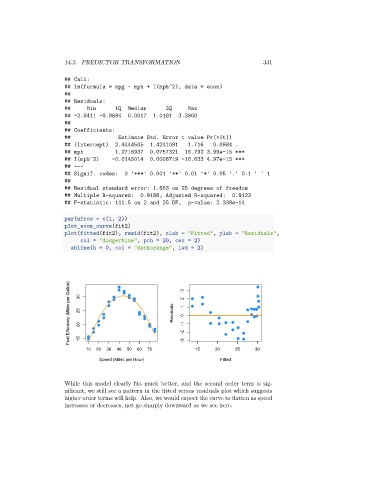
                      While this model clearly fits much better, and the second order term is sig-
                      nificant, we still see a pattern in the fitted versus residuals plot which suggests
                      higher order terms will help. Also, we would expect the curve to flatten as speed
                      increases or decreases, not go sharply downward as we see here.

