


Page 348 - First Aid for the USMLE Step 1 2020, Thirtieth edition [MedicalBooksVN.com]_Neat
P. 348
304 SECTION III CARDIOvASCuLAR ``CARdIOvASCulAR—PATHOlOGY CARDIOvASCuLAR ``CARdIOvASCulAR—PATHOlOGY
Ischemic heart disease manifestations
Angina Chest pain due to ischemic myocardium 2° to coronary artery narrowing or spasm; no myocyte
necrosis.
Stable—usually 2° to atherosclerosis (≥ 70% occlusion); exertional chest pain in classic
distribution (usually with ST depression on ECG), resolving with rest or nitroglycerin.
Vasospastic (also called Prinzmetal or Variant)—occurs at rest 2° to coronary artery
spasm; transient ST elevation on ECG. Smoking is a risk factor; hypertension and
hypercholesterolemia are not. Triggers include cocaine, alcohol, and triptans. Treat with Ca
2+
channel blockers, nitrates, and smoking cessation (if applicable).
Unstable—thrombosis with incomplete coronary artery occlusion; +/− ST depression and/or
T-wave inversion on ECG but no cardiac biomarker elevation (unlike NSTEMI); in frequency
or intensity of chest pain or any chest pain at rest.
Coronary steal Distal to coronary stenosis, vessels are maximally dilated at baseline. Administration of vasodilators
syndrome (eg, dipyridamole, regadenoson) dilates normal vessels blood is shunted toward well-perfused
areas ischemia in myocardium perfused by stenosed vessels. Principle behind pharmacologic
stress tests with coronary vasodilators.
Sudden cardiac death Death from cardiac causes within 1 hour of onset of symptoms, most commonly due to a lethal
arrhythmia (eg, VF). Associated with CAD (up to 70% of cases), cardiomyopathy (hypertrophic,
dilated), and hereditary ion channelopathies (eg, long QT syndrome, Brugada syndrome). Prevent
with ICD.
Chronic ischemic Progressive onset of HF over many years due to chronic ischemic myocardial damage.
heart disease
Myocardial infarction Most often due to rupture of coronary artery atherosclerotic plaque acute thrombosis. cardiac
biomarkers (CK-MB, troponins) are diagnostic.
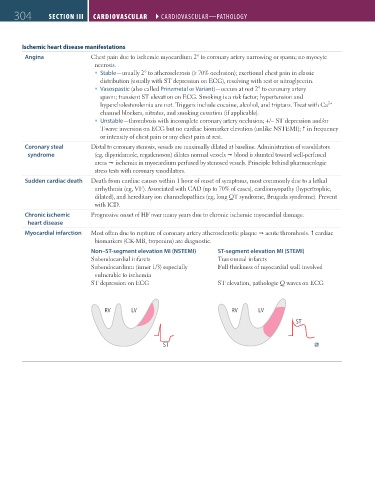
Non–ST-segment elevation MI (NSTEMI) ST-segment elevation MI (STEMI)
Subendocardial infarcts Transmural infarcts
Subendocardium (inner 1/3) especially Full thickness of myocardial wall involved
vulnerable to ischemia
ST depression on ECG ST elevation, pathologic Q waves on ECG
RV LV RV LV RV LV RV LV
ST ST
ST ST
FAS1_2019_07-Cardio.indd 304 11/7/19 4:24 PM

