


Page 347 - First Aid for the USMLE Step 1 2020, Thirtieth edition [MedicalBooksVN.com]_Neat
P. 347
CARDIOvASCuLAR ``CARdIOvASCulAR—PATHOlOGY CARDIOvASCuLAR ``CARdIOvASCulAR—PATHOlOGY SECTION III 303
Traumatic aortic Due to trauma and/or deceleration injury, most commonly at aortic isthmus (proximal descending
rupture aorta just distal to origin of left subclavian artery). X-ray may reveal widened mediastinum.
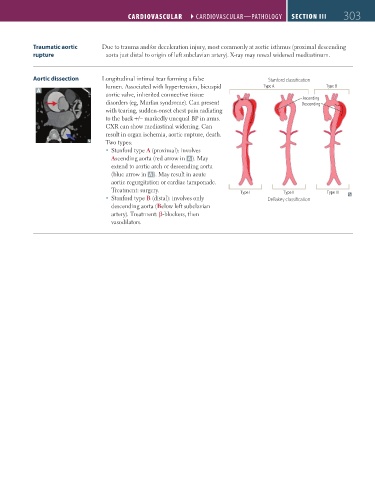
Aortic dissection Longitudinal intimal tear forming a false Stanford classification
lumen. Associated with hypertension, bicuspid Type A Type B
A
aortic valve, inherited connective tissue
Ascending
disorders (eg, Marfan syndrome). Can present Descending
with tearing, sudden-onset chest pain radiating
to the back +/− markedly unequal BP in arms.
CXR can show mediastinal widening. Can
result in organ ischemia, aortic rupture, death.
Two types:
Stanford type A (proximal): involves
Ascending aorta (red arrow in A ). May
extend to aortic arch or descending aorta
(blue arrow in A ). May result in acute
aortic regurgitation or cardiac tamponade.
Treatment: surgery. Type I Type II Type III
Stanford type B (distal): involves only DeBakey classification
descending aorta (Below left subclavian
artery). Treatment: β-blockers, then
vasodilators.
FAS1_2019_07-Cardio.indd 303 11/7/19 4:24 PM

