


Page 400 - Python Data Science Handbook
P. 400
1. Impute missing values using the mean
                2. Transform features to quadratic
                3. Fit a linear regression

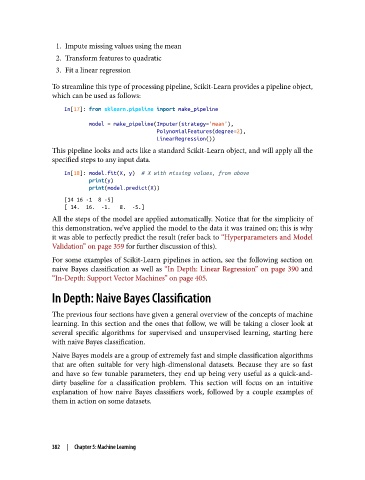
               To streamline this type of processing pipeline, Scikit-Learn provides a pipeline object,
               which can be used as follows:
                   In[17]: from sklearn.pipeline import make_pipeline

                           model = make_pipeline(Imputer(strategy='mean'),
                                                 PolynomialFeatures(degree=2),
                                                 LinearRegression())
               This pipeline looks and acts like a standard Scikit-Learn object, and will apply all the
               specified steps to any input data.
                   In[18]: model.fit(X, y)  # X with missing values, from above
                           print(y)
                           print(model.predict(X))
                   [14 16 -1  8 -5]
                   [ 14.  16.  -1.   8.  -5.]
               All the steps of the model are applied automatically. Notice that for the simplicity of
               this demonstration, we’ve applied the model to the data it was trained on; this is why
               it was able to perfectly predict the result (refer back to “Hyperparameters and Model
               Validation” on page 359 for further discussion of this).
               For some examples of Scikit-Learn pipelines in action, see the following section on
               naive Bayes classification as well as “In Depth: Linear Regression”  on page 390  and
               “In-Depth: Support Vector Machines” on page 405.

               In Depth: Naive Bayes Classification

               The previous four sections have given a general overview of the concepts of machine
               learning. In this section and the ones that follow, we will be taking a closer look at
               several specific algorithms for supervised and unsupervised learning, starting here
               with naive Bayes classification.
               Naive Bayes models are a group of extremely fast and simple classification algorithms
               that are often suitable for very high-dimensional datasets. Because they are so fast
               and have so few tunable parameters, they end up being very useful as a quick-and-
               dirty baseline for a classification problem. This section will focus on an intuitive
               explanation of how naive Bayes classifiers work, followed by a couple examples of
               them in action on some datasets.


               382  |  Chapter 5: Machine Learning

