


Page 395 - Python Data Science Handbook
P. 395
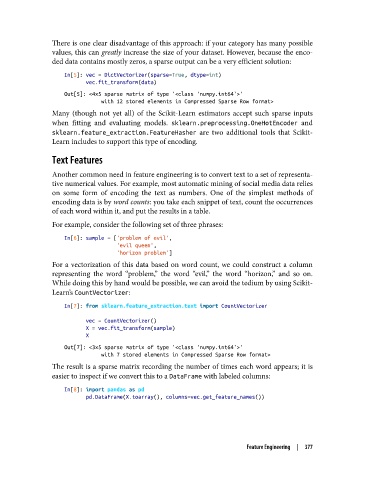
There is one clear disadvantage of this approach: if your category has many possible
               values, this can greatly increase the size of your dataset. However, because the enco‐
               ded data contains mostly zeros, a sparse output can be a very efficient solution:
                   In[5]: vec = DictVectorizer(sparse=True, dtype=int)
                          vec.fit_transform(data)
                   Out[5]: <4x5 sparse matrix of type '<class 'numpy.int64'>'
                               with 12 stored elements in Compressed Sparse Row format>
               Many (though not yet all) of the Scikit-Learn estimators accept such sparse inputs
               when fitting and evaluating models. sklearn.preprocessing.OneHotEncoder  and
               sklearn.feature_extraction.FeatureHasher  are two additional tools that Scikit-
               Learn includes to support this type of encoding.
               Text Features

               Another common need in feature engineering is to convert text to a set of representa‐
               tive numerical values. For example, most automatic mining of social media data relies
               on some form of encoding the text as numbers. One of the simplest methods of
               encoding data is by word counts: you take each snippet of text, count the occurrences
               of each word within it, and put the results in a table.
               For example, consider the following set of three phrases:
                   In[6]: sample = ['problem of evil',
                                    'evil queen',
                                    'horizon problem']
               For a vectorization of this data based on word count, we could construct a column
               representing the word “problem,” the word “evil,” the word “horizon,” and so on.
               While doing this by hand would be possible, we can avoid the tedium by using Scikit-
               Learn’s CountVectorizer:
                   In[7]: from sklearn.feature_extraction.text import CountVectorizer

                          vec = CountVectorizer()
                          X = vec.fit_transform(sample)
                          X
                   Out[7]: <3x5 sparse matrix of type '<class 'numpy.int64'>'
                               with 7 stored elements in Compressed Sparse Row format>
               The result is a sparse matrix recording the number of times each word appears; it is
               easier to inspect if we convert this to a DataFrame with labeled columns:
                   In[8]: import pandas as pd
                          pd.DataFrame(X.toarray(), columns=vec.get_feature_names())


                                                                     Feature Engineering  |  377

