


Page 398 - Python Data Science Handbook
P. 398
It’s clear that we need a more sophisticated model to describe the relationship
               between x and y. We can do this by transforming the data, adding extra columns of
               features to drive more flexibility in the model. For example, we can add polynomial
               features to the data this way:

                   In[12]: from sklearn.preprocessing import PolynomialFeatures
                           poly = PolynomialFeatures(degree=3, include_bias=False)
                           X2 = poly.fit_transform(X)
                           print(X2)
                   [[   1.    1.    1.]
                    [   2.    4.    8.]
                    [   3.    9.   27.]
                    [   4.   16.   64.]
                    [   5.   25.  125.]]
               The derived feature matrix has one column representing x, and a second column rep‐
                         2
                                                        3
               resenting x , and a third column representing x . Computing a linear regression on
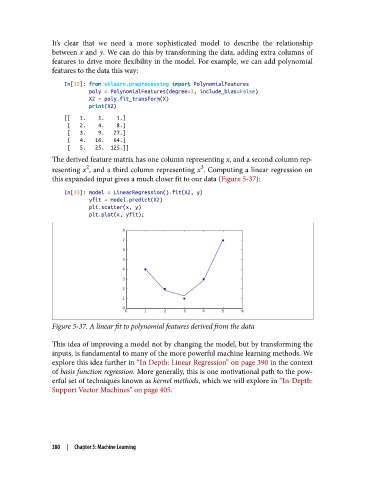
               this expanded input gives a much closer fit to our data (Figure 5-37):
                   In[13]: model = LinearRegression().fit(X2, y)
                           yfit = model.predict(X2)
                           plt.scatter(x, y)
                           plt.plot(x, yfit);


               Figure 5-37. A linear fit to polynomial features derived from the data

               This idea of improving a model not by changing the model, but by transforming the
               inputs, is fundamental to many of the more powerful machine learning methods. We
               explore this idea further in “In Depth: Linear Regression” on page 390 in the context
               of basis function regression. More generally, this is one motivational path to the pow‐
               erful set of techniques known as kernel methods, which we will explore in “In-Depth:
               Support Vector Machines” on page 405.


               380  |  Chapter 5: Machine Learning

