


Page 399 - Python Data Science Handbook
P. 399
Imputation of Missing Data

               Another common need in feature engineering is handling missing data. We discussed
               the handling of missing data in DataFrames in “Handling Missing Data” on page 119,
               and saw that often the NaN  value is used to mark missing values. For example, we
               might have a dataset that looks like this:

                   In[14]: from numpy import nan
                           X = np.array([[ nan, 0,   3  ],
                                         [ 3,   7,   9  ],
                                         [ 3,   5,   2  ],
                                         [ 4,   nan, 6  ],
                                         [ 8,   8,   1  ]])
                           y = np.array([14, 16, -1,  8, -5])
               When applying a typical machine learning model to such data, we will need to first
               replace such missing data with some appropriate fill value. This is known as imputa‐
               tion of missing values, and strategies range from simple (e.g., replacing missing values
               with the mean of the column) to sophisticated (e.g., using matrix completion or a
               robust model to handle such data).

               The sophisticated approaches tend to be very application-specific, and we won’t dive
               into them here. For a baseline imputation approach, using the mean, median, or most
               frequent value, Scikit-Learn provides the Imputer class:
                   In[15]: from sklearn.preprocessing import Imputer
                           imp = Imputer(strategy='mean')
                           X2 = imp.fit_transform(X)
                           X2
                   Out[15]: array([[ 4.5,  0. ,  3. ],
                                   [ 3. ,  7. ,  9. ],
                                   [ 3. ,  5. ,  2. ],
                                   [ 4. ,  5. ,  6. ],
                                   [ 8. ,  8. ,  1. ]])
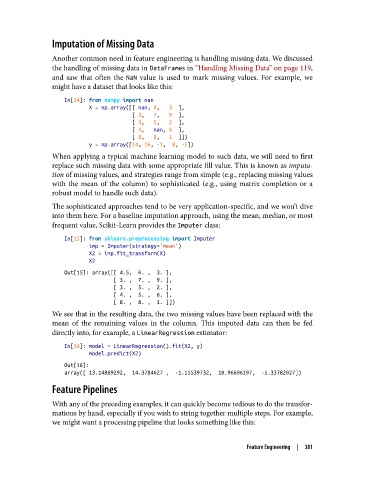
               We see that in the resulting data, the two missing values have been replaced with the
               mean of the remaining values in the column. This imputed data can then be fed
               directly into, for example, a LinearRegression estimator:

                   In[16]: model = LinearRegression().fit(X2, y)
                           model.predict(X2)
                   Out[16]:
                   array([ 13.14869292,  14.3784627 ,  -1.15539732,  10.96606197,  -5.33782027])
               Feature Pipelines

               With any of the preceding examples, it can quickly become tedious to do the transfor‐
               mations by hand, especially if you wish to string together multiple steps. For example,
               we might want a processing pipeline that looks something like this:


                                                                     Feature Engineering  |  381

