


Page 416 - Python Data Science Handbook
P. 416
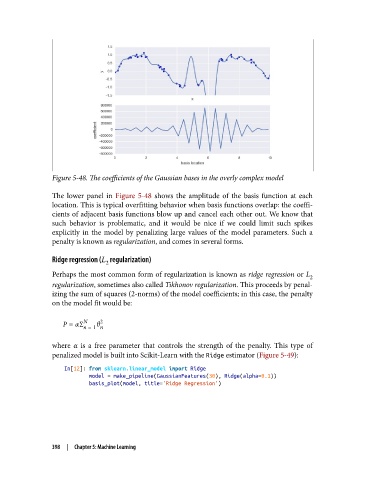
Figure 5-48. The coecients of the Gaussian bases in the overly complex model
The lower panel in Figure 5-48 shows the amplitude of the basis function at each
location. This is typical overfitting behavior when basis functions overlap: the coeffi‐
cients of adjacent basis functions blow up and cancel each other out. We know that
such behavior is problematic, and it would be nice if we could limit such spikes
explicitly in the model by penalizing large values of the model parameters. Such a
penalty is known as regularization, and comes in several forms.
Ridge regression (L regularization)
2
Perhaps the most common form of regularization is known as ridge regression or L 2
regularization, sometimes also called Tikhonov regularization. This proceeds by penal‐
izing the sum of squares (2-norms) of the model coefficients; in this case, the penalty
on the model fit would be:
P = α∑ N θ 2
n = 1 n
where α is a free parameter that controls the strength of the penalty. This type of
penalized model is built into Scikit-Learn with the Ridge estimator (Figure 5-49):
In[12]: from sklearn.linear_model import Ridge
model = make_pipeline(GaussianFeatures(30), Ridge(alpha=0.1))
basis_plot(model, title='Ridge Regression')
398 | Chapter 5: Machine Learning

