


Page 437 - Python Data Science Handbook
P. 437
In[25]: from sklearn.metrics import classification_report
                           print(classification_report(ytest, yfit,
                                                       target_names=faces.target_names))
                                      precision    recall  f1-score   support

                        Ariel Sharon       0.65      0.73      0.69        15
                        Colin Powell       0.81      0.87      0.84        68
                     Donald Rumsfeld       0.75      0.87      0.81        31
                       George W Bush       0.93      0.83      0.88       126
                   Gerhard Schroeder       0.86      0.78      0.82        23
                         Hugo Chavez       0.93      0.70      0.80        20
                   Junichiro Koizumi       0.80      1.00      0.89        12
                          Tony Blair       0.83      0.93      0.88        42

                         avg / total       0.85      0.85      0.85       337
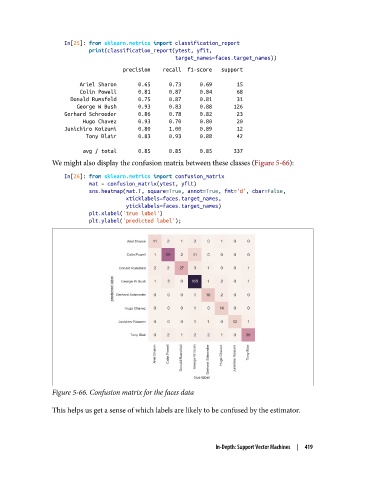
               We might also display the confusion matrix between these classes (Figure 5-66):

                   In[26]: from sklearn.metrics import confusion_matrix
                           mat = confusion_matrix(ytest, yfit)
                           sns.heatmap(mat.T, square=True, annot=True, fmt='d', cbar=False,
                                       xticklabels=faces.target_names,
                                       yticklabels=faces.target_names)
                           plt.xlabel('true label')
                           plt.ylabel('predicted label');


               Figure 5-66. Confusion matrix for the faces data

               This helps us get a sense of which labels are likely to be confused by the estimator.


                                                             In-Depth: Support Vector Machines  |  419

