


Page 436 - Python Data Science Handbook
P. 436
%time grid.fit(Xtrain, ytrain)
                           print(grid.best_params_)
                   CPU times: user 47.8 s, sys: 4.08 s, total: 51.8 s
                   Wall time: 26 s
                   {'svc__gamma': 0.001, 'svc__C': 10}
               The optimal values fall toward the middle of our grid; if they fell at the edges, we
               would want to expand the grid to make sure we have found the true optimum.
               Now with this cross-validated model, we can predict the labels for the test data, which
               the model has not yet seen:
                   In[23]: model = grid.best_estimator_
                           yfit = model.predict(Xtest)
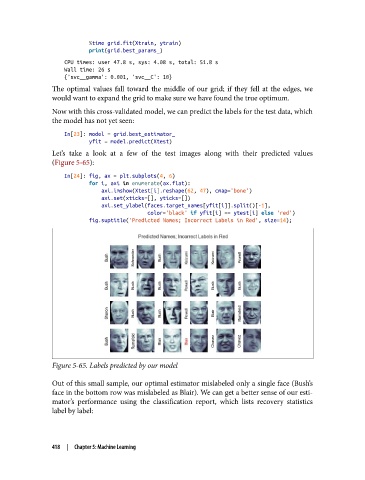
               Let’s take a look at a few of the test images along with their predicted values
               (Figure 5-65):

                   In[24]: fig, ax = plt.subplots(4, 6)
                           for i, axi in enumerate(ax.flat):
                               axi.imshow(Xtest[i].reshape(62, 47), cmap='bone')
                               axi.set(xticks=[], yticks=[])
                               axi.set_ylabel(faces.target_names[yfit[i]].split()[-1],
                                              color='black' if yfit[i] == ytest[i] else 'red')
                           fig.suptitle('Predicted Names; Incorrect Labels in Red', size=14);


               Figure 5-65. Labels predicted by our model

               Out of this small sample, our optimal estimator mislabeled only a single face (Bush’s
               face in the bottom row was mislabeled as Blair). We can get a better sense of our esti‐
               mator’s performance using the classification report, which lists recovery statistics
               label by label:


               418  |  Chapter 5: Machine Learning

