


Page 435 - Python Data Science Handbook
P. 435
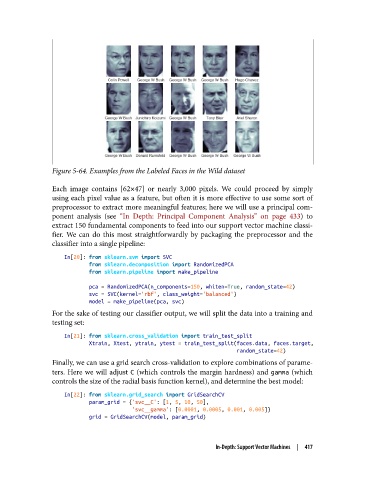
Figure 5-64. Examples from the Labeled Faces in the Wild dataset


               Each image contains [62×47] or nearly 3,000 pixels. We could proceed by simply
               using each pixel value as a feature, but often it is more effective to use some sort of
               preprocessor to extract more meaningful features; here we will use a principal com‐
               ponent analysis (see “In Depth: Principal Component Analysis” on page 433) to
               extract 150 fundamental components to feed into our support vector machine classi‐
               fier. We can do this most straightforwardly by packaging the preprocessor and the
               classifier into a single pipeline:

                   In[20]: from sklearn.svm import SVC
                           from sklearn.decomposition import RandomizedPCA
                           from sklearn.pipeline import make_pipeline

                           pca = RandomizedPCA(n_components=150, whiten=True, random_state=42)
                           svc = SVC(kernel='rbf', class_weight='balanced')
                           model = make_pipeline(pca, svc)
               For the sake of testing our classifier output, we will split the data into a training and
               testing set:
                   In[21]: from sklearn.cross_validation import train_test_split
                           Xtrain, Xtest, ytrain, ytest = train_test_split(faces.data, faces.target,
                                                                           random_state=42)
               Finally, we can use a grid search cross-validation to explore combinations of parame‐
               ters. Here we will adjust C  (which controls the margin hardness) and gamma  (which
               controls the size of the radial basis function kernel), and determine the best model:
                   In[22]: from sklearn.grid_search import GridSearchCV
                           param_grid = {'svc__C': [1, 5, 10, 50],
                                         'svc__gamma': [0.0001, 0.0005, 0.001, 0.005]}
                           grid = GridSearchCV(model, param_grid)


                                                             In-Depth: Support Vector Machines  |  417

