


Page 439 - Python Data Science Handbook
P. 439
In-Depth: Decision Trees and Random Forests


               Previously we have looked in depth at a simple generative classifier (naive Bayes; see
               “In Depth: Naive Bayes Classification” on page 382) and a powerful discriminative
               classifier (support vector machines; see “In-Depth: Support Vector Machines” on
               page 405). Here we’ll take a look at motivating another powerful algorithm—a non‐
               parametric algorithm called random forests. Random forests are an example of an
               ensemble method, a method that relies on aggregating the results of an ensemble of
               simpler estimators. The somewhat surprising result with such ensemble methods is
               that the sum can be greater than the parts; that is, a majority vote among a number of
               estimators can end up being better than any of the individual estimators doing the
               voting! We will see examples of this in the following sections. We begin with the stan‐
               dard imports:

                   In[1]: %matplotlib inline
                          import numpy as np
                          import matplotlib.pyplot as plt
                          import seaborn as sns; sns.set()
               Motivating Random Forests: Decision Trees

               Random forests are an example of an ensemble learner built on decision trees. For this
               reason we’ll start by discussing decision trees themselves.

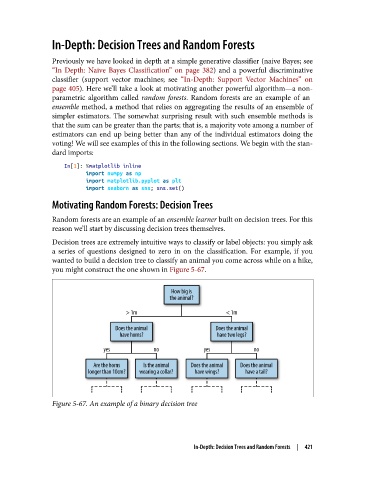
               Decision trees are extremely intuitive ways to classify or label objects: you simply ask
               a series of questions designed to zero in on the classification. For example, if you
               wanted to build a decision tree to classify an animal you come across while on a hike,
               you might construct the one shown in Figure 5-67.


               Figure 5-67. An example of a binary decision tree


                                                       In-Depth: Decision Trees and Random Forests  |  421

