


Page 445 - Python Data Science Handbook
P. 445
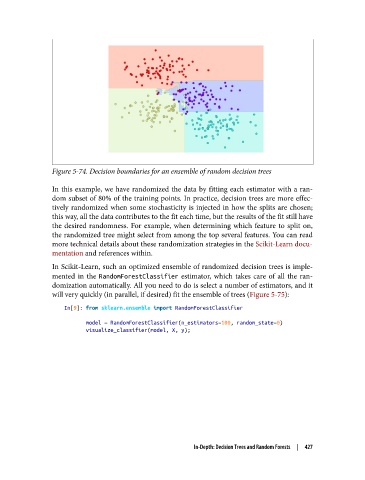
Figure 5-74. Decision boundaries for an ensemble of random decision trees

               In this example, we have randomized the data by fitting each estimator with a ran‐
               dom subset of 80% of the training points. In practice, decision trees are more effec‐
               tively randomized when some stochasticity is injected in how the splits are chosen;
               this way, all the data contributes to the fit each time, but the results of the fit still have
               the desired randomness. For example, when determining which feature to split on,
               the randomized tree might select from among the top several features. You can read
               more technical details about these randomization strategies in the Scikit-Learn docu‐
               mentation and references within.
               In Scikit-Learn, such an optimized ensemble of randomized decision trees is imple‐
               mented in the RandomForestClassifier  estimator, which takes care of all the ran‐
               domization automatically. All you need to do is select a number of estimators, and it
               will very quickly (in parallel, if desired) fit the ensemble of trees (Figure 5-75):
                   In[9]: from sklearn.ensemble import RandomForestClassifier

                          model = RandomForestClassifier(n_estimators=100, random_state=0)
                          visualize_classifier(model, X, y);


                                                       In-Depth: Decision Trees and Random Forests  |  427

