


Page 450 - Python Data Science Handbook
P. 450
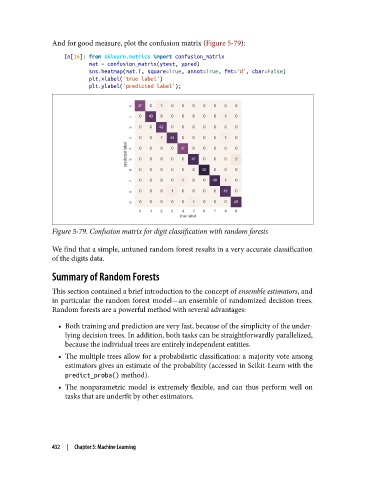
And for good measure, plot the confusion matrix (Figure 5-79):

                   In[16]: from sklearn.metrics import confusion_matrix
                           mat = confusion_matrix(ytest, ypred)
                           sns.heatmap(mat.T, square=True, annot=True, fmt='d', cbar=False)
                           plt.xlabel('true label')
                           plt.ylabel('predicted label');


               Figure 5-79. Confusion matrix for digit classification with random forests

               We find that a simple, untuned random forest results in a very accurate classification
               of the digits data.
               Summary of Random Forests

               This section contained a brief introduction to the concept of ensemble estimators, and
               in particular the random forest model—an ensemble of randomized decision trees.
               Random forests are a powerful method with several advantages:

                 • Both training and prediction are very fast, because of the simplicity of the under‐
                   lying decision trees. In addition, both tasks can be straightforwardly parallelized,
                   because the individual trees are entirely independent entities.
                 • The multiple trees allow for a probabilistic classification: a majority vote among
                   estimators gives an estimate of the probability (accessed in Scikit-Learn with the
                   predict_proba() method).
                 • The nonparametric model is extremely flexible, and can thus perform well on
                   tasks that are underfit by other estimators.


               432  |  Chapter 5: Machine Learning

