


Page 446 - Python Data Science Handbook
P. 446
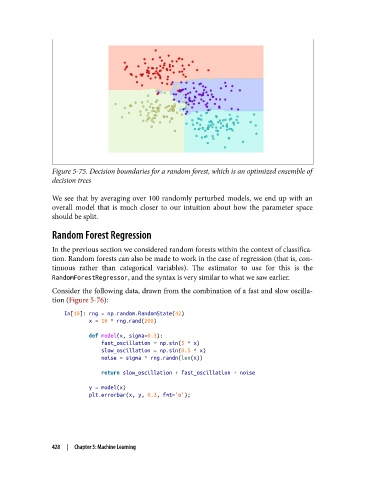
Figure 5-75. Decision boundaries for a random forest, which is an optimized ensemble of
               decision trees

               We see that by averaging over 100 randomly perturbed models, we end up with an
               overall model that is much closer to our intuition about how the parameter space
               should be split.

               Random Forest Regression

               In the previous section we considered random forests within the context of classifica‐
               tion. Random forests can also be made to work in the case of regression (that is, con‐
               tinuous rather than categorical variables). The estimator to use for this is the
               RandomForestRegressor, and the syntax is very similar to what we saw earlier.
               Consider the following data, drawn from the combination of a fast and slow oscilla‐
               tion (Figure 5-76):
                   In[10]: rng = np.random.RandomState(42)
                           x = 10 * rng.rand(200)
                           def model(x, sigma=0.3):
                               fast_oscillation = np.sin(5 * x)
                               slow_oscillation = np.sin(0.5 * x)
                               noise = sigma * rng.randn(len(x))

                               return slow_oscillation + fast_oscillation + noise
                           y = model(x)
                           plt.errorbar(x, y, 0.3, fmt='o');


               428  |  Chapter 5: Machine Learning

