


Page 452 - Python Data Science Handbook
P. 452
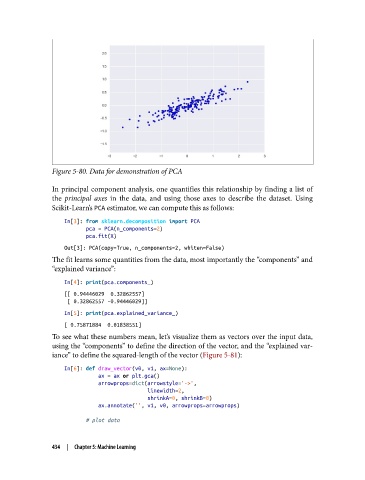
Figure 5-80. Data for demonstration of PCA

               In principal component analysis, one quantifies this relationship by finding a list of
               the principal axes  in the data, and using those axes to describe the dataset. Using
               Scikit-Learn’s PCA estimator, we can compute this as follows:

                   In[3]: from sklearn.decomposition import PCA
                          pca = PCA(n_components=2)
                          pca.fit(X)
                   Out[3]: PCA(copy=True, n_components=2, whiten=False)
               The fit learns some quantities from the data, most importantly the “components” and
               “explained variance”:

                   In[4]: print(pca.components_)
                   [[ 0.94446029  0.32862557]
                    [ 0.32862557 -0.94446029]]
                   In[5]: print(pca.explained_variance_)
                   [ 0.75871884  0.01838551]
               To see what these numbers mean, let’s visualize them as vectors over the input data,
               using the “components” to define the direction of the vector, and the “explained var‐
               iance” to define the squared-length of the vector (Figure 5-81):

                   In[6]: def draw_vector(v0, v1, ax=None):
                              ax = ax or plt.gca()
                              arrowprops=dict(arrowstyle='->',
                                              linewidth=2,
                                              shrinkA=0, shrinkB=0)
                              ax.annotate('', v1, v0, arrowprops=arrowprops)

                          # plot data


               434  |  Chapter 5: Machine Learning

