


Page 460 - Python Data Science Handbook
P. 460
In[15]: pca = PCA(0.50).fit(noisy)
                           pca.n_components_
                   Out[15]: 12
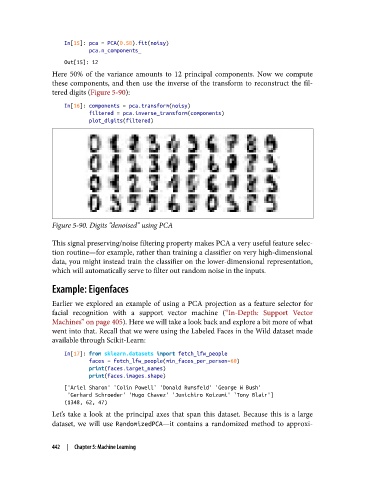
               Here 50% of the variance amounts to 12 principal components. Now we compute
               these components, and then use the inverse of the transform to reconstruct the fil‐
               tered digits (Figure 5-90):

                   In[16]: components = pca.transform(noisy)
                           filtered = pca.inverse_transform(components)
                           plot_digits(filtered)


               Figure 5-90. Digits “denoised” using PCA

               This signal preserving/noise filtering property makes PCA a very useful feature selec‐
               tion routine—for example, rather than training a classifier on very high-dimensional
               data, you might instead train the classifier on the lower-dimensional representation,
               which will automatically serve to filter out random noise in the inputs.
               Example: Eigenfaces

               Earlier we explored an example of using a PCA projection as a feature selector for
               facial recognition with a support vector machine (“In-Depth: Support Vector
               Machines” on page 405). Here we will take a look back and explore a bit more of what
               went into that. Recall that we were using the Labeled Faces in the Wild dataset made
               available through Scikit-Learn:
                   In[17]: from sklearn.datasets import fetch_lfw_people
                           faces = fetch_lfw_people(min_faces_per_person=60)
                           print(faces.target_names)
                           print(faces.images.shape)
                   ['Ariel Sharon' 'Colin Powell' 'Donald Rumsfeld' 'George W Bush'
                    'Gerhard Schroeder' 'Hugo Chavez' 'Junichiro Koizumi' 'Tony Blair']
                   (1348, 62, 47)
               Let’s take a look at the principal axes that span this dataset. Because this is a large
               dataset, we will use RandomizedPCA—it contains a randomized method to approxi‐


               442  |  Chapter 5: Machine Learning

