


Page 19 - Spotlight A+ Form 4 & 5 Chemistry KSSM
P. 19
Form
                                                                                                           4
                                                                    Chapter 5 Chemical Bond   Chemistry


                                                           Paper 1


                   1.  Which of the following pairs of physical
                     properties of sodium oxide, Na O is true?  C2  C
                                              2
                    ©PAN ASIA PUBLICATIONS
                         Solubility in  Electrical conductivity
                           water         when molten                D
                     A Soluble       Conducting
                     B Soluble       Not conducting
                     C Insoluble     Not conducting
                     D Insoluble     Conducting
                                                                  6.  Ethanol, C H OH is a covalent compound that
                                                                               5
                                                                             2
                   2.  Which of the following substances is a covalent   can dissolve in water. Which of the following
                     compound?  C1                                  explain the solubility of ethanol, C H OH in
                     A  Magnesium chloride, MgCl                    water?  C2                    2  5
                     B  Calcium oxide, CaO                          A  Ethanol molecules ionise in water.
                     C  Lead(II) chloride, PbCl 2                   B  Ethanol molecules form hydrogen bonds
                     D  Carbon dioxide, CO 2                           with water molecules.
                                                                    C  Ethanol molecules form dative bonds with
                   3.  The following shows information of a few        water molecules.
                     elements.                                      D  Ethanol molecules donate electron to water
                                   V:  Sulphur                         molecules.
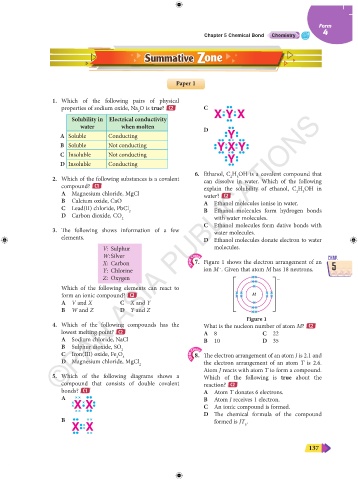
 CHAP.                             W: Silver                      7.  Figure 1 shows the electron arrangement of an   CHAP.
                                                                SPM Clone
 5                                 X:  Carbon                       ion M  . Given that atom M has 18 neutrons.   5
                                                                         –
                                   Y:  Chlorine
                                   Z:  Oxygen                                               –
                     Which  of the following elements can react to
                     form an ionic compound?  C2                                    M
                     A  V and X         C  X and Y
                     B  W and Z         D  Y and Z
                                                                                  Figure 1
                   4.  Which  of the following compounds has the    What is the nucleon number of atom M?  C2
                     lowest melting point?  C2                      A  8               C  22
                     A  Sodium chloride, NaCl                       B  10              D  35
                     B  Sulphur dioxide, SO 2
                                                                SPM Clone
                     C  Iron(III) oxide, Fe O 3                   8.  The electron arrangement of an atom J is 2.1 and
                                       2
                     D  Magnesium chloride, MgCl                    the  electron  arrangement  of  an  atom  T  is  2.6.
                                               2
                                                                    Atom J reacts with atom T to form a compound.
                   5.  Which of  the following  diagrams shows a    Which  of the following  is  true  about the
                     compound  that  consists  of  double  covalent   reaction?  C2
                     bonds?  C1                                     A  Atom T donates 6 electrons.
                     A                                              B  Atom J receives 1 electron.
                                                                    C  An ionic compound is formed.
                                                                    D  The chemical formula of the compound
                     B                                                 formed is JT .
                                                                                 6


                                                                                                      137

