


Page 21 - Spotlight A+ Form 4 & 5 Chemistry KSSM
P. 21
Form
                                                                                                           4
                                                                    Chapter 5 Chemical Bond   Chemistry

                                                           Paper 2
                                                          Section A

                 SPM Clone                                                                         [1 mark]
                  1.  (a)  (i)  The electron arrangement of neon is 2.8. Why is this element  very stable?  C2
                        (ii)  Name another element that has the same stability as neon.  C1        [1 mark]
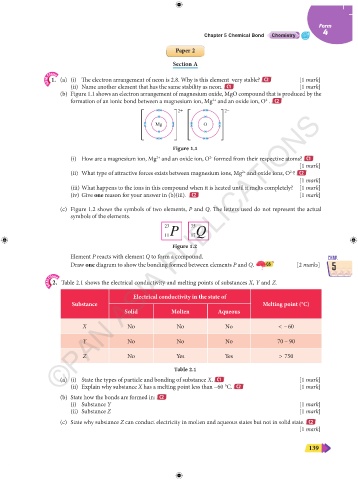
                     (b)  Figure 1.1 shows an electron arrangement of magnesium oxide, MgO compound that is produced by the
                                                                                        2–
                        formation of an ionic bond between a magnesium ion, Mg  and an oxide ion, O .  C2
                                                                       2+
                                                           2+              2–
                                                    Mg              O


                                                          Figure 1.1
                        (i)  How are a magnesium ion, Mg  and an oxide ion, O  formed from their respective atoms?  C1
                                                                      2-
                                                    2+
                                                                                                   [1 mark]
                                                                                                2-
                        (ii)  What type of attractive forces exists between magnesium ions, Mg  and oxide ions, O ?  C2
                                                                                2+
                                                                                                   [1 mark]
                        (iii) What happens to the ions in this compound when it is heated until it melts completely?   [1 mark]
                        (iv)  Give one reason for your answer in (b)(iii).   C2                    [1 mark]
                     (c)  Figure 1.2 shows the symbols of two elements, P and Q. The letters used do not represent the actual
                        symbols of the elements.

                                                       23       35
                                                       11P      17Q

                                                          Figure 1.2
                        Element P reacts with element Q to form a compound.
 CHAP.                ©PAN ASIA PUBLICATIONS                                                                 CHAP.
 5                      Draw one diagram to show the bonding formed between elements P and Q.   C6  [2 marks]  5
                  SPM Clone
                   2.  Table 2.1 shows the electrical conductivity and melting points of substances X, Y and Z.

                                             Electrical conductivity in the state of
                         Substance                                                     Melting point (°C)
                                          Solid          Molten         Aqueous

                            X              No              No              No               <  – 60

                            Y              No              No              No               70 – 90

                            Z              No              Yes             Yes               >  750

                                                          Table 2.1
                     (a)  (i)  State the types of particle and bonding of substance X.  C1         [1 mark]
                        (ii)  Explain why substance X has a melting point less than – 60 °C.  C2     [1 mark]
                     (b)  State how the bonds are formed in:  C2
                        (i)  Substance Y                                                            [1 mark]
                        (ii)  Substance Z                                                           [1 mark]

                     (c)  State why substance Z can conduct electricity in molten and aqueous states but not in solid state.  C2
                                                                                                    [1 mark]


                                                                                                      139

